
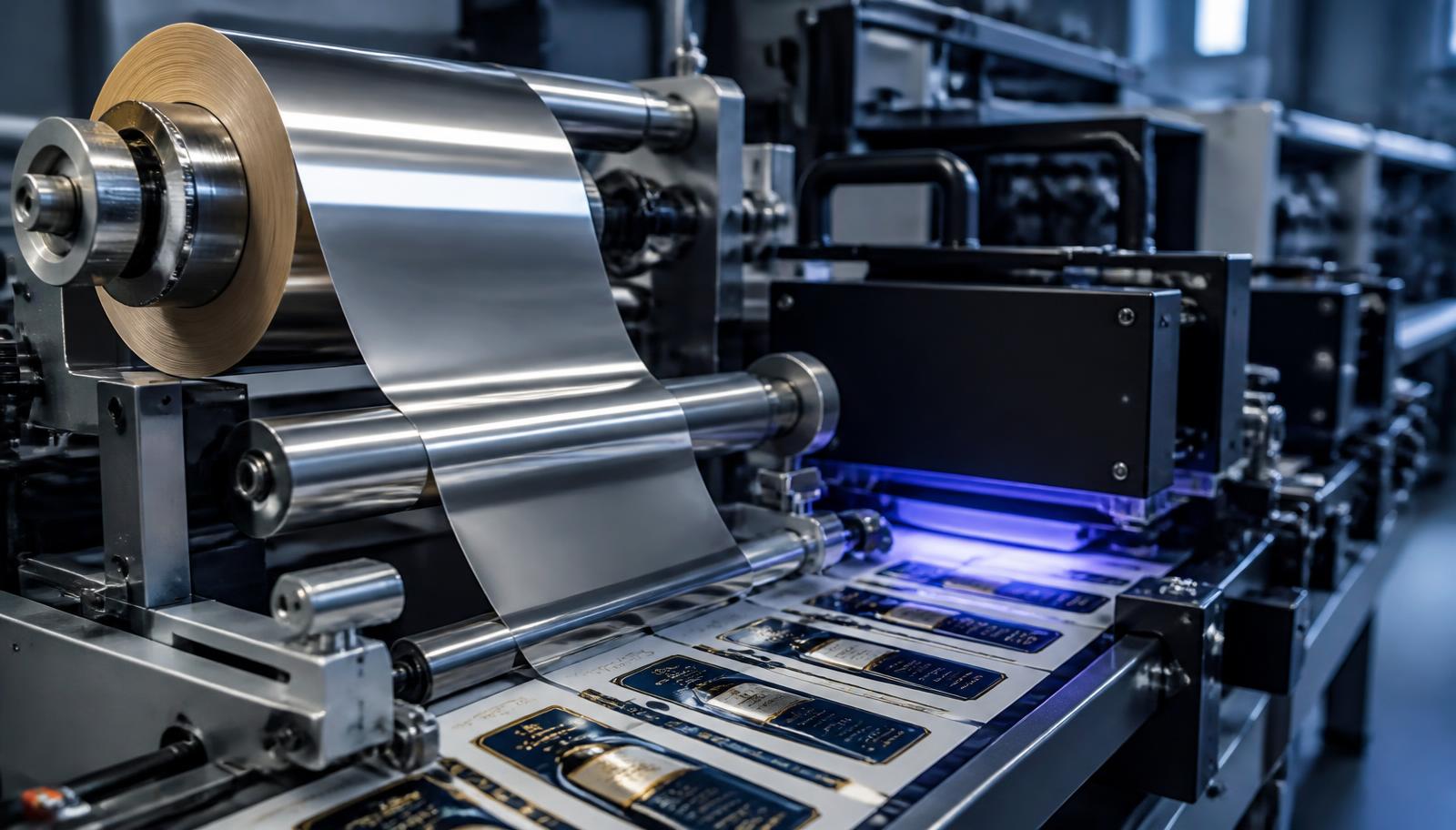
A supplier-side read of the global cold foil market in 2026: market size, end-use verticals, regional demand, equipment concentration and where the segment is actually heading — with the confidence levels stated honestly.
Table of Contents
- 1. The Market Sizing Problem
- 2. Where Cold Foil Actually Gets Used
- 3. Geographic Distribution
- 4. The Equipment Landscape
- 5. The Global Supplier Landscape
- 6. The China Cold Foil Story Specifically
- 7. Four Shifts Worth Watching Into 2026-2027
- 8. Practical Guidance
- 9. Where This Analysis Is Weakest
- Frequently Asked Questions
By Gavin Gao — 15+ years in hot stamping foil, cold foil and post-press machinery. Reach me at gavin@allinpacks.com or on LinkedIn.
Most published analysis of the cold foil market is written by two groups: equipment manufacturers pitching their next inline flexo unit, and analyst firms selling $4,500 reports built on interviews with roughly the same twelve people. Both sources are useful. Both share a bias — they benefit commercially from cold foil looking like a high-momentum segment.
Cold foil is growing. That part is true. But the picture from the supply side is more textured than the equipment-vendor narrative, and several shifts in 2025-2026 have not been covered properly anywhere I can find.
I have been in foil supply since 2010, split roughly evenly between post-press machinery and foil production. I have watched cold foil go from a European converter novelty in the late 2000s to what is now, on any reasonable estimate, the fastest-growing foil decoration segment globally. What follows is my attempt to describe that market honestly, drawing on supply-side visibility, factory visits across Europe and Asia over six years, and what can be triangulated from public equipment shipments and producer statements.
The caveat first: nobody publishes reliable global cold foil data. Kurz, which almost certainly holds the best internal picture, does not share it. Analyst houses extrapolate from small samples. Numbers below are hedged, and I flag where confidence is low.
1. The Market Sizing Problem
Defined narrowly — the value of cold foil consumed by converters worldwide, excluding the equipment that applies it — the global market sits somewhere between $850 million and $1.2 billion annually in 2025. That is a wide range and I will not pretend I can tighten it honestly. My working central estimate is about $1 billion, and even that rests on assumptions I cannot fully defend.
Growth is easier to characterise than absolute size. Cold foil consumption has compounded at roughly 6-9% CAGR since 2019, meaningfully ahead of hot stamping foil (2-4% over the same window) and far ahead of packaging decoration overall. If you had to choose one foil segment to supply on growth alone, cold foil is the answer.
Why it grows is worth unpacking, because most analysis attributes it to sustainability, which is only partly right.
- Material efficiency. A well-tuned cold foil operation achieves 85-92% foil web utilisation, against 55-70% for typical hot stamping running discrete patches. That difference flows straight into unit economics at almost any real-world run length.
- Inline integration. Cold foil runs inline with flexo and offset presses, removing a separate finishing pass. This is a labour and working-capital story more than a green one: no dedicated stamping operator, no warehousing of half-finished goods between print and finishing, one production window instead of two.
- Substrate range. Cold foil decorates materials that will not tolerate the heat and pressure of hot stamping — thin films, heat-sensitive stocks, certain pressure-sensitive label constructions. As substrate variety widened, the addressable market widened with it.
The sustainability narrative is real but oversimplified. Cold foil avoids the direct heat energy hot stamping needs, but it spends UV curing energy on the transfer adhesive. Net energy per decorated square metre is closer between the two processes than "green cold foil" marketing implies, and depends heavily on the curing technology (mercury lamp versus LED) and coverage ratio. Life cycle analyses I have seen put the two within about 15% of each other. If you are weighing the two processes commercially rather than environmentally, our hot vs cold foil stamping comparison sets out the trade-offs job by job.
2. Where Cold Foil Actually Gets Used
The end-use split drives everything downstream, and it is less balanced than most published charts suggest. Shares below are volume-based and are my estimates, not measurements.
| Vertical | Share of global cold foil volume | Direction |
|---|---|---|
| Wine & spirits labels | 30-35% | Growing |
| Cosmetics & personal care | 20-25% | Growing |
| Health & wellness packaging | 10-12% | Growing fast |
| Folding carton (offset cold foil) | 10-15% | Plateauing |
| Flexible packaging | 5-8% | Stable |
| Cards, collateral, direct mail | 3-5% | Digital-driven |
| Tobacco, automotive, industrial | 5-10% | Declining |
Wine and spirits labels are the single largest consuming vertical globally, and it is not close. Premium wine, spirits — whisky, tequila, premium vodka above all — and increasingly craft beer with metallic label elements drove adoption faster than any other consumer category. Cold foil rode the decade-long shift from paper labels to metallised decoration on high-end SKUs.
Cosmetics and personal care comes second. More fragmented geographically, but the aggregate is enormous: shampoo labels, tube shoulders, hair care, premium skincare. Metallic decoration is now close to standard on mid-tier and above.
Health and wellness deserves separating from cosmetics. Supplements, OTC pharmaceutical cartons that are not restricted to non-foil constructions, and the fast-growing functional beverage category — kombucha, functional water, premium energy drinks. Where those SKUs need tamper or authenticity features as well as shelf appeal, buyers usually move to security foil rather than plain metallic.
Folding carton decoration on offset is the segment I size with least confidence. Offset cold foil expanded quickly for cosmetics outer cartons, premium food and gifting, and grew faster than flexo cold foil between 2020 and 2024 — though it may now be plateauing.
Cards, collateral and marketing pieces are a small but visible tail, and this is where digital cold foil is finding genuine traction, because it is the only route with true short-run economics. For toner-based short runs the competing route is digital toner-reactive foil, which needs no press modification at all.
3. Geographic Distribution
| Region | Share of global demand | Annual growth |
|---|---|---|
| Europe | 35-40% | 4-6% |
| North America | 25-30% | 6-8% |
| Asia Pacific | 20-25% | 10-14% |
| Latin America, Middle East & Africa | 10-15% | Estimate only |
Europe leads consumption, reflecting early adoption of inline cold foil by European converters, the density of premium wine and spirits production, and a more aggressive regulatory environment around decoration processes. Germany, Italy and France are the largest single-country consumers; the UK, Spain and Poland form a second tier.
North America skews more heavily to spirits and cosmetics, with less wine exposure than Europe. Craft beverage has been the strongest growth driver over the past five years.
Asia Pacific is the fastest-growing region. China is the largest single market by volume, though a meaningful share of that consumption leaves the country on exported packaging — electronics, cosmetics for regional and global brands, textile hangtags. Japan and South Korea are distinct converter industries in their own right, and Vietnam, Thailand and Indonesia are growing quickly from a small base. That regional pattern lines up with what we see in the export record; the same dynamic shows up in the India import data.
Latin America and Middle East/Africa together make up the remainder. My visibility here is materially weaker, and those numbers are estimate rather than analysis.
4. The Equipment Landscape
Cold foil consumption is capped by how many presses can apply it, which makes equipment shipments the best leading indicator of future demand.
The flexo cold foil unit market is highly concentrated. MPS Systems (Netherlands), Nilpeter (Denmark) and Mark Andy (US) together account for well over half of global inline flexo cold foil installations. Gallus (Switzerland, Heidelberg-owned) is fourth. The remainder is scattered across specialist builders and Chinese machine manufacturers whose share is climbing fast in Asia but is still small globally.
Offset is more concentrated still. Kurz's DM-JETLINER, integrated with KBA and Heidelberg platforms, dominates offset cold foil to a degree few equipment segments match. Alternatives exist, but for a converter buying offset cold foil capability the practical choice is Kurz's system in the large majority of cases.
I toured the MPS cold foil demonstration facility in Raamsdonksveer in 2023, and what stayed with me was how much of the value sits in parameters that never appear on a spec sheet: nip pressure profile, adhesive viscosity control across web speed changes, foil web tension management. Operator experience dominates here, and mistuning can drop yields from above 90% to 65% overnight. Buyers evaluating a first installation should read our cold foil printing machine guide before they read any vendor brochure.
New flexo cold foil installations have been running at roughly 200-280 units per year over the last three years, with Asia Pacific taking around 40% of them despite holding a smaller share of installed base. That weighting is the strongest single indicator I know that Asian cold foil consumption will keep outrunning global growth for several years yet.
5. The Global Supplier Landscape
Cold foil supply is a smaller market than hot stamping foil supply, but its supplier structure differs in interesting ways.
- Kurz is the global leader, with the DM-LINER foil range and the DM-JETLINER offset system. Its integration of foil chemistry, equipment and converter training is genuinely industry-defining; strip Kurz out and the remaining market would look materially different.
- API Group (UK, acquired by Kurz in 2020 — the two operate with substantial commercial independence, but the ownership matters) holds strong European share, particularly in cosmetics and specialty labels.
- Crown Roll Leaf (US) has strong North American share and a solid technical reputation in specialty holographic cold foil.
- ITW Foils and Univacco (Taiwan, with mainland production) are meaningful mid-tier suppliers with distinct regional strengths.
- Chinese producers are where the market has changed most in five years — covered below.
On standard flexo cold foil, Chinese quality has genuinely caught up with mid-tier European specification over the last three to four years. On high-end registered holographic and colour-critical work, Chinese producers still trail global specialists meaningfully. But on standard bright metallic cold foil for volume converters, the gap has closed far enough that price becomes the primary decision factor for most buyers.
I should be careful here: "the gap has closed" is a supplier's judgement from my own network. Some Kurz customers would dispute it firmly, and their strongest argument — that Kurz's technical support and long-run process consistency are hard to match at commodity pricing — is a real one. Chinese cold foil typically prices 40-60% below equivalent European specification, a gap wide enough that even converters who prefer European supply keep a Chinese secondary source live for price control. A structured view of who supplies what is in our comparison of Chinese foil manufacturers.
6. The China Cold Foil Story Specifically
My direct visibility is strongest on the Chinese supply side, so this section carries more detail than the others.
Production is concentrated in the Wenzhou industrial cluster in Zhejiang province, with meaningful additional capacity in Suqian (Jiangsu) and Guangdong. The leading producers have collectively invested in cold foil-specific coating lines over the past five years — some building reputation on cost-competitive standard cold foil, others on pattern-registered cold foil for decorative work.
Export destinations skew toward Southeast Asia (Vietnam, Indonesia, Thailand, Malaysia), the Middle East, Russia and CIS, Latin America and increasingly Africa. Volumes into European and North American converters exist but form a smaller share, mostly buyers who are commercially open to Chinese supply and have a technical evaluation process capable of qualifying it against an incumbent baseline.
One under-appreciated dynamic: Chinese producers are far more willing than global brands to develop custom patterns for medium-volume regional accounts. If a mid-sized Vietnamese or Indonesian converter wants a bespoke holographic pattern originated for one brand customer, a Chinese producer will usually quote it where a European specialist declines the volume commitment. That single behaviour has moved real market share in Southeast Asia.
On the customs record: Chinese foil exports under HS 32121000 bundle cold and hot stamping foil at the line-item level, so the cold foil slice cannot be isolated cleanly. Tonnage has grown steadily and unit prices have edged up since late 2023. Supply-side estimates put cold foil at roughly 20-25% of Chinese total foil export tonnage, up from perhaps 12-15% five years ago. The full dataset behind that view — 66 months, 146 destinations, 30 origin provinces — is in our free China Foil Export Report 2026.
7. Four Shifts Worth Watching Into 2026-2027
- Water-based UV cold foil adhesives — 60% confidence. Moving from laboratory curiosity to commercial deployment in Europe under regulatory pressure on solvent-based UV chemistry. I would put it at 60% that water-based systems become mainstream for new EU installations within 30 months, with knock-on effects on foil chemistry: release layers must be reformulated for the different adhesive interaction.
- Digital cold foil growth — 55% confidence. Systems from Scodix, MGI and others have existed for years in a small niche. The niche is growing in personalisation, small-batch spirits and cosmetics, and marketing collateral. Conventional cold foil still wins at any real run length, so this is a genuine niche rather than a displacement.
- Recyclable cold foil constructions — direction certain, timing not. Metallised PET carriers complicate paper recycling streams. Several producers are working on aluminium-free metallic-effect films and thinner carriers. Progress has been slower than the marketing suggests, but I expect at least one commercially meaningful launch from a major supplier within 18 months.
- Supply chain consolidation — high confidence, already visible. Kurz/API in 2020, Heidelberg's ownership of Gallus, other tie-ups. Independent mid-tier suppliers face rising pressure. This cuts two ways: it strengthens Kurz in the premium tier and simultaneously widens the opening for price-competitive Chinese alternatives.
8. Practical Guidance
If you are a converter adding cold foil capability: the equipment decision matters more than the foil supplier decision. Choose the supplier whose local technical support you trust over the one whose spec sheet reads slightly better. Throughput and yield depend heavily on operator experience, and training programme quality varies enormously. Once installed, switching foil suppliers is comparatively easy.
If you are a buyer evaluating cold foil suppliers: run genuine head-to-head sample tests before committing volume. Quality differences show on the decorated substrate, not on the roll. Test blind, on your actual production stock, with your actual UV adhesive. Never take "equivalent to Kurz specification" at face value — ask for it in writing as an acceptance criterion instead.
If you are a brand owner choosing between cold and hot stamping: cold foil generally wins on inline production economics, throughput and heat-sensitive substrates. Hot stamping generally wins on fine-detail decoration precision, combined emboss-and-foil tactile effects, and finishes that must survive long shelf storage in high humidity. Both are excellent when matched correctly to the application. If you want a specification opinion on a live job, send us the artwork and substrate and we will tell you which route we would run it on, including when the answer is not ours.
9. Where This Analysis Is Weakest
Two honest limitations. First, my visibility into Latin American and African cold foil markets is far weaker than into Asia, Europe and North America; those characterisations rest on secondhand converter conversations and limited public data rather than direct facility experience. Second, this is supplier-side analysis throughout. A converter with twenty years operating cold foil equipment would give you a more accurate picture of daily operational reality than I can. Cross-check anything I have said about equipment behaviour or process economics against your own converter contacts.
If you hold better data on any of these dimensions — the regional numbers or the vertical breakdowns especially — I would genuinely welcome the correction. Cold foil knowledge is scattered across supplier, equipment and converter perspectives, and no single vantage point sees the whole picture.
Reviewed by Gavin Gao, Technical Director at All-in Pack. Fifteen-plus years of technical experience across hot stamping foil, cold foil and post-press machinery, covering foil chemistry, converter process economics and buyer-side technical evaluation in multiple global markets.
This analysis sits alongside our work on Chinese foil export flows for 2021 through H1 2026, built on official GACC customs data covering 66 months and 146 destination countries. The full report is free at allinpacks.com/reports/china-foil-export-2026.
Frequently Asked Questions
Quick answers about cold foil.
Companion Products
Specs and samples for the products discussed in this article.
Related Articles
View all
Industry News · Aug 25, 2026
Top 10 Chinese Cold Foil Manufacturers Compared (2026)
A cold foil supplier's honest comparison of the ten most relevant Chinese cold foil producers in 2026 — grouped by specialty across volume flexo, pattern-registered, holographic and integrated supply, with application-based routing guidance.

Technical Knowledge · Aug 25, 2026
Foil Stamping vs Digital Foil vs Cold Foil: Which Method Actually Wins on Cost?
An honest four-part cost comparison of hot foil stamping, cold foil and digital foil — tooling, material, machine time and changeover — plus the run-length crossover points, substrate limits and lower-cost alternatives to foil altogether.
Technical Knowledge · Apr 21, 2026
Hot Foil vs Cold Foil vs Digital Foil: 2026 Comparison
Compare hot foil, cold foil, and digital foil to find the best foiling method for your packaging needs. This guide offers insights on metallic finishes.
Ready to source foil stamping and die-cutting from one supplier?
From stamping foils to post-press machines and die-cutting consumables — get factory-direct pricing and free samples.