
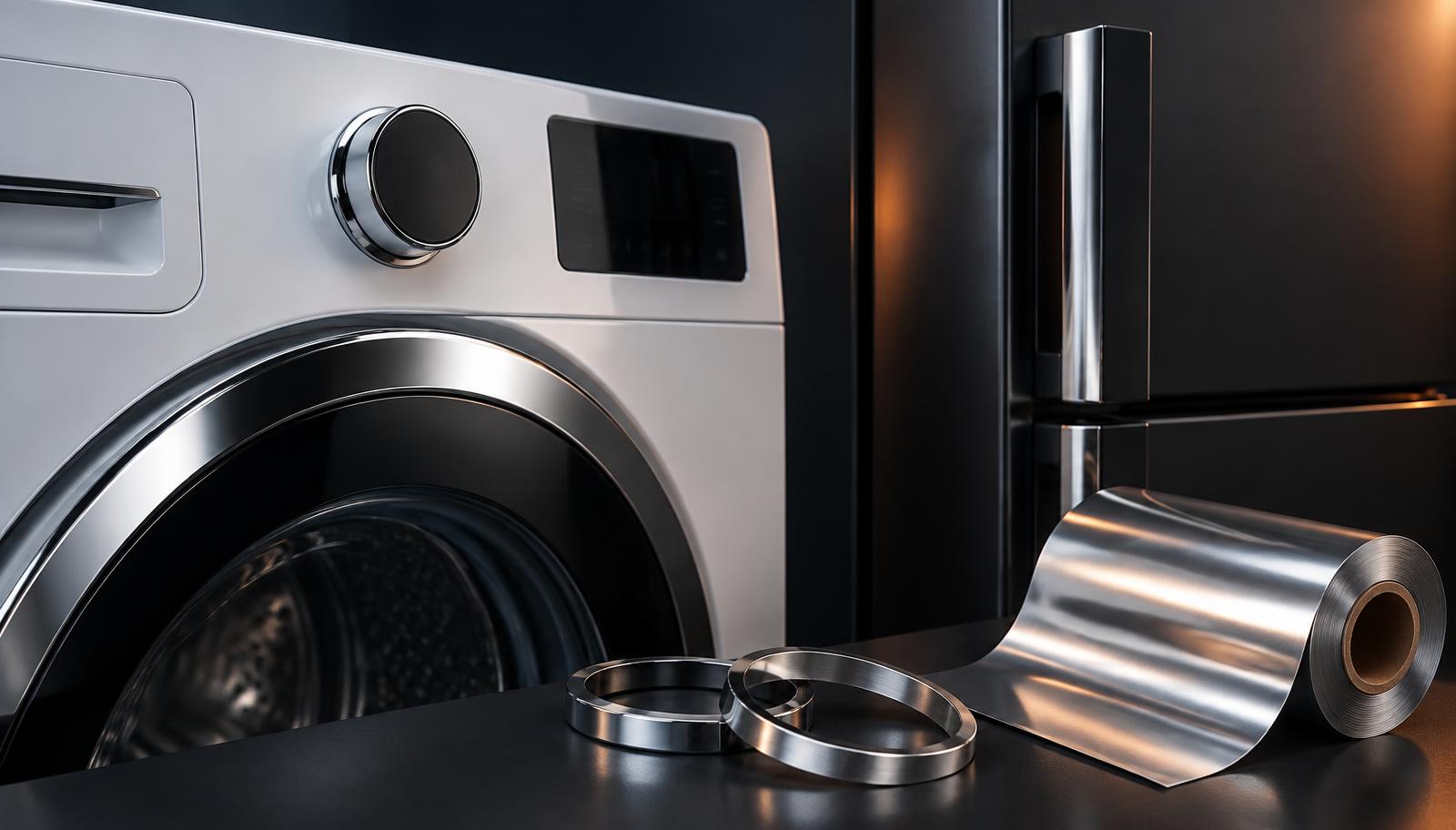
How to hot stamp washing machine, refrigerator, air conditioner and microwave panels as a plating-free alternative to chrome electroplating — the 6-layer foil structure, aluminium vs chrome metallising, 3 weatherability levels, process settings, an 8-fault fix table and validation tests.
Table of Contents
- Why appliance makers are moving from chrome plating to foil
- The 6-layer structure of appliance hot stamping foil
- Aluminium vs chrome metallised foil
- Choose by weatherability level
- Where hot stamping is used on appliances
- Stamping methods by part shape
- Starting settings by panel material
- Troubleshooting table: 8 common faults
- 7-step setup for a new appliance panel
- Durability tests appliance brands ask for
- Hot stamping vs IMD vs screen printing for panels
- Get foil and tooling for your appliance panels
- Frequently Asked Questions
By Gavin Gao — 15+ years in foil stamping and post-press supply at All-in Pack. Reach me at sales@allinpacks.com.
Quick answer: Home appliance panel hot stamping uses a heated die, silicone pad or roller to transfer a 1.5–3 µm metallised or pigment foil layer onto ABS, PC, PMMA or PET panels. It is a dry, plating-free way to add chrome trims, logos and markings. Success depends on foil adhesive matched to the panel, a clean surface, controlled heat at the part and even pressure — fix them in that order.
The settings in this guide are industry starting points, not guarantees. Every resin, film, ink and hot stamping foil grade behaves differently, so confirm each change on a test panel.
Why appliance makers are moving from chrome plating to foil
EU REACH restrictions on chromium trioxide — the key substance in hexavalent decorative chrome plating — are tightening, with further limits widely expected around 2027–2028. Brands that still want a "chrome look" on knobs, rings and trims are therefore evaluating dry decoration processes.
| Process | Main pain point | How hot stamping foil compares |
|---|---|---|
| Hexavalent chrome plating | Regulatory pressure, wastewater treatment, trivalent alternatives can look yellower | No plating baths, no hexavalent chromium, no wastewater; colour does not drift with bath chemistry |
| PVD / NCVM | High capital cost, batch processing, recesses hard to coat | Equipment cost roughly an order of magnitude lower; selective decoration; continuous cycle |
| Chrome-effect paint | Weaker abrasion and weathering, flake orientation hard to control | Vacuum-metallised layer gives a more uniform, true mirror finish |
| Stainless steel / die-cast trim | Weight, cost, limited shape freedom | Lighter plastic parts with a metal-grade appearance |
The 6-layer structure of appliance hot stamping foil
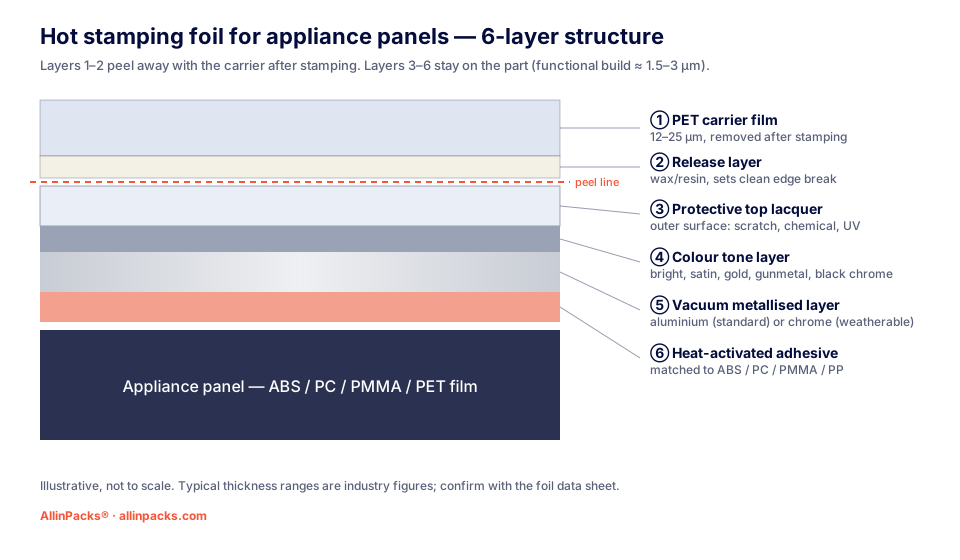
Layers ① and ② peel away with the carrier after stamping. Layers ③–⑥ stay on the panel and together are only about 1.5–3 µm thick (published industry figures).
- PET carrier film (12–25 µm) — holds the coating through the machine and is rewound after stamping.
- Release layer — controls how cleanly the foil breaks at the artwork edge; it decides fine-text sharpness and flashing.
- Protective top lacquer — becomes the outer surface of the part. Its crosslink density sets scratch, alcohol and detergent resistance; UV absorbers and stabilisers limit yellowing and gloss loss.
- Colour tone layer — sets the hue: bright chrome, satin chrome, gold, gunmetal or black chrome.
- Vacuum metallised layer — the mirror. Standard foils use aluminium; weatherable chrome-effect foils use vacuum-deposited chromium, which does not oxidise like aluminium in humid or salty conditions and matches the cooler tone of plated chrome.
- Heat-activated adhesive — must be formulated for the panel resin (ABS, PC, PMMA, PP or printed film). Most adhesion failures start here.
Aluminium vs chrome metallised foil
| Item | Standard decorative foil | Chrome-effect weatherable foil |
|---|---|---|
| Metal layer | Vacuum aluminium (can oxidise and dull in humidity/salt) | Vacuum chromium (non-oxidising, corrosion-resistant) |
| Colour | Bright, whiter silver | Cooler, deeper "true chrome" tone |
| Top lacquer | General abrasion resistance | UV-stabilised, high-crosslink weatherable system |
| Validation | Appearance + basic adhesion | Xenon/QUV ageing, CASS or salt spray, humidity cycling |
| Typical use | Indoor small parts, packaging | Long-life appliance surfaces, outdoor products, automotive trim |
Choose by weatherability level
| Level | Environment | Typical parts | Design focus |
|---|---|---|---|
| L1 — Indoor appliance | Kitchens, laundry rooms | Control knobs, panel frames, logo plates | Cleaners, hand sweat, grease, daily abrasion |
| L2 — Outdoor product | Patios, coastal areas | BBQ knob rings, heater trims, garden tool badges | UV and salt-spray resistance |
| L3 — Automotive | Vehicle interiors / exteriors | Button rings, trims, emblems | OEM specifications (see our automotive trim guide) |
Where hot stamping is used on appliances
| Appliance | Typical part | Common material | Typical foil |
|---|---|---|---|
| Washing machine / dryer | Control panel, programme dial ring, brand logo | ABS, PC film, PMMA | Brushed silver, bright chrome, pigment white |
| Refrigerator | Door handle trim, display window frame, logo | ABS, PS, PMMA | Bright chrome, matte silver |
| Air conditioner | Front panel strip, display frame, logo | ABS, PC, PET film | Chrome, gold, pigment colours |
| Microwave / oven | Control panel markings, door trim | PC film, PET film | Pigment black/white, silver |
| Small appliances (kettle, rice cooker) | Buttons, rings, logos | PP, ABS, PC | Silver, gold, coloured metallic |
Stamping methods by part shape
- Up-and-down (vertical) stamping — a heated metal hot stamping die or silicone pad presses straight down. Best for logos, markings, buttons and flat panels.
- Roll-on stamping — a heated silicone roller rolls foil across raised ribs, rings and long trim strips. Best for curved or long features.
- Peripheral stamping — the part rotates against a heated roller to decorate the side ring of a knob or cap.
- Sheet-fed film panels — flat PC or PET overlay films can also be foiled before forming or die-cutting on a flatbed press, then cut with a steel rule cutting die.
Hot stamping suits flat to 2.5D parts. For deep 3D shapes, evaluate IMD, PVD or NCVM instead.
Starting settings by panel material
| Material | Die temperature | Roller temperature | Dwell / speed | Pretreatment |
|---|---|---|---|---|
| ABS | 130–160 °C | 180–220 °C | 0.5–1.5 s · 3–8 m/min | Clean only |
| PC / PC film | 140–180 °C | 190–230 °C | 0.8–2.0 s · 2–6 m/min | Clean, avoid stress cracking |
| PMMA (acrylic) | 120–150 °C | 170–210 °C | 0.5–1.2 s | Clean, low pressure |
| PET film | 120–150 °C | — | 0.5–1.0 s | Check print/coating compatibility |
| PP | 140–170 °C | 180–220 °C | 1.0–2.0 s | Flame or plasma to ≥38 mN/m |
Silicone pads and rollers read hotter than the part surface because silicone loses heat through its thickness. For general theory, see our hot stamping temperature, pressure and dwell time chart.
Troubleshooting table: 8 common faults
| Fault | Most likely cause | Fix |
|---|---|---|
| Foil peels in tape test | Wrong foil adhesive, release agent on panel, heat too low | Clean with IPA, confirm surface energy, use a substrate-matched foil, raise heat 5 °C at a time |
| Blurred edges / fill-in on fine text | Heat or pressure too high, dwell too long | Lower temperature first, then pressure; sharpen die engraving depth |
| Incomplete transfer (patchy) | Uneven pressure, warped panel, worn pad | Shim the fixture, support the panel fully, replace the silicone pad |
| Dull or hazy chrome | Overheating, textured panel surface, foil without hard lacquer | Reduce heat and dwell, use a high-gloss metallised foil |
| Panel distortion or whitening | Too much heat on thin walls or PC film | Lower temperature, shorten dwell, use a lower-melt foil adhesive |
| Foil flashing (extra foil around artwork) | Foil too thick to break cleanly, heat too high | Use a cleaner-breaking foil grade, reduce heat |
| Pinholes / spots | Dust, static, outgassing from inks | Ionise and clean, dry printed panels fully before stamping |
| Scratches after assembly | Soft foil lacquer, poor packing | Specify abrasion-resistant foil, add protective film |
7-step setup for a new appliance panel
- Confirm the panel material, surface finish and any print or hard coat.
- Clean a test panel with IPA and check surface energy with dyne pens.
- Choose a foil with an adhesive rated for that material.
- Build a rigid fixture that supports the panel under the full stamping area.
- Start at the foil's lower temperature limit with light pressure.
- Raise temperature in 5 °C steps, then pressure, then dwell — one variable at a time.
- Run cross-hatch, rub and heat-ageing tests before approving the settings, and record a parameter card for production.
Durability tests appliance brands ask for
- Cross-hatch adhesion with tape
- Alcohol, detergent or rub resistance
- Abrasion or eraser test
- Heat and humidity ageing
- Thermal cycling
- Grease and cleaning chemical resistance (kitchen appliances)
- For L2/L3 parts: xenon-arc or QUV ageing and CASS or neutral salt-spray exposure
Hot stamping vs IMD vs screen printing for panels
| Method | Best for | Tooling cost | Metallic look |
|---|---|---|---|
| Hot stamping | Logos, trims, markings, short–medium runs | Low (die or pad) | Excellent, true mirror chrome |
| IMD / IML | Full-surface graphics, very high volume | High (moulds + films) | Good, via printed film |
| Screen printing | Flat text and colour fills | Low | Limited |
Get foil and tooling for your appliance panels
All-in Pack supplies hot stamping foils, hot stamping dies, silicone pads and mounting tape. Send us the panel material, artwork and target tests, and we will recommend a foil grade and tooling.
Frequently Asked Questions
Quick answers about appliance panel hot stamping.
Companion Products
Specs and samples for the products discussed in this article.
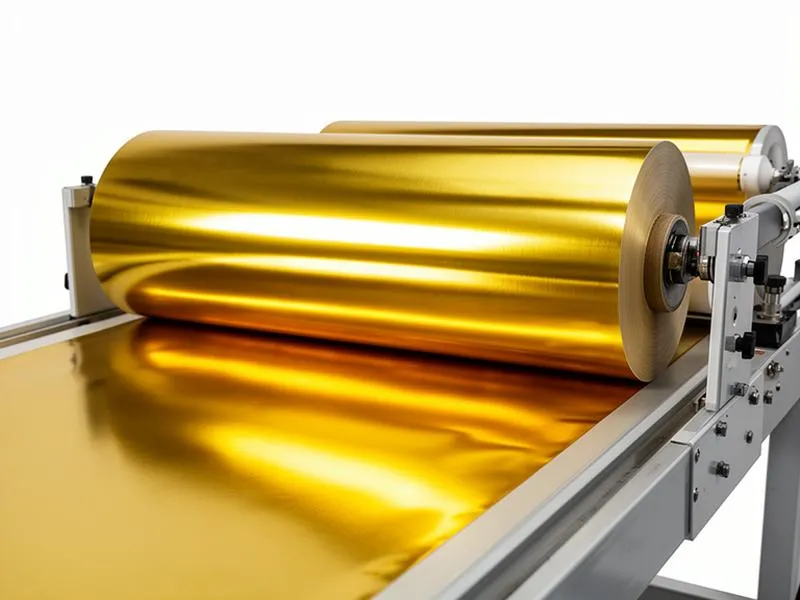
Premium Metallic Gold Hot Stamping Foil
Ultra-bright metallic gold foil with mirror-like reflection for premium packaging and label applications.
View product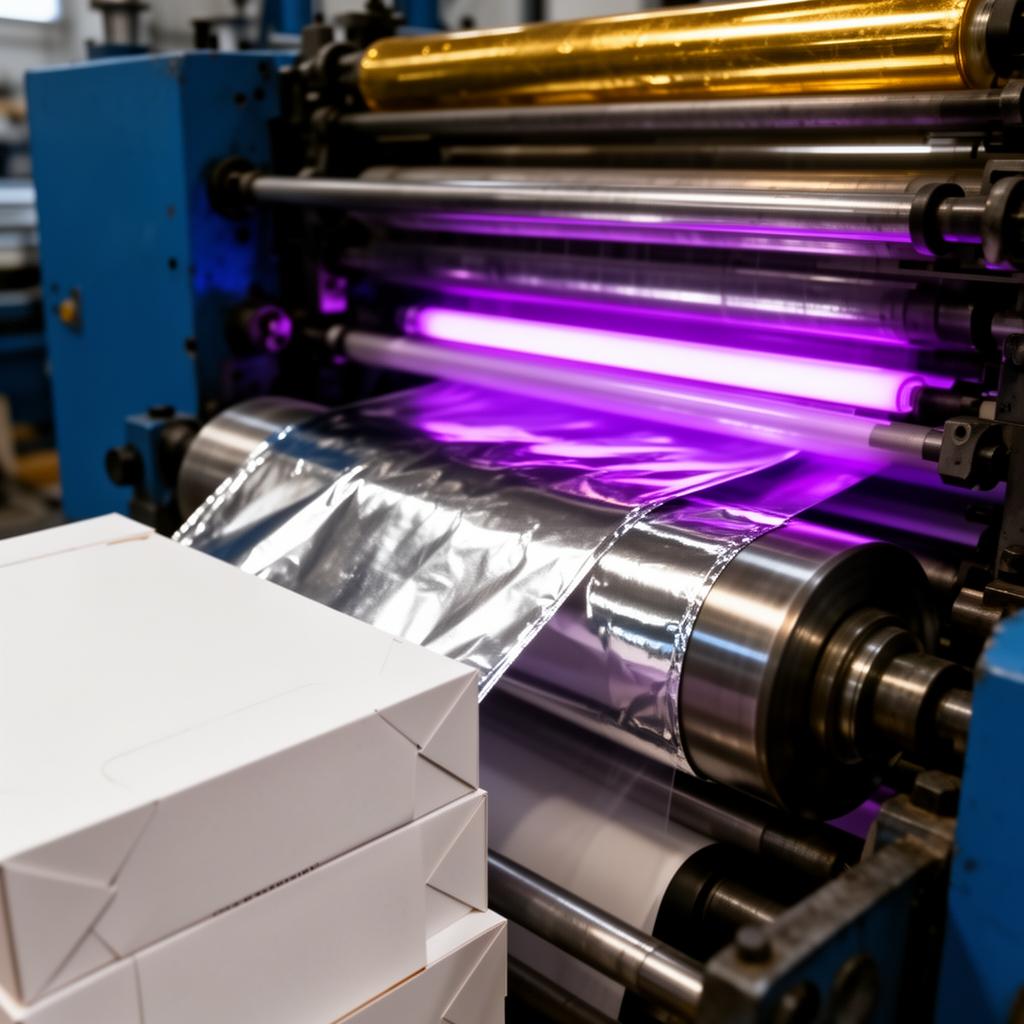
Cold Stamping Foil
Cold stamping foil for inline UV flexo and offset presses — no heat, no dies, up to 150 m/min with metallic, holographic and pigmented finishes.
View product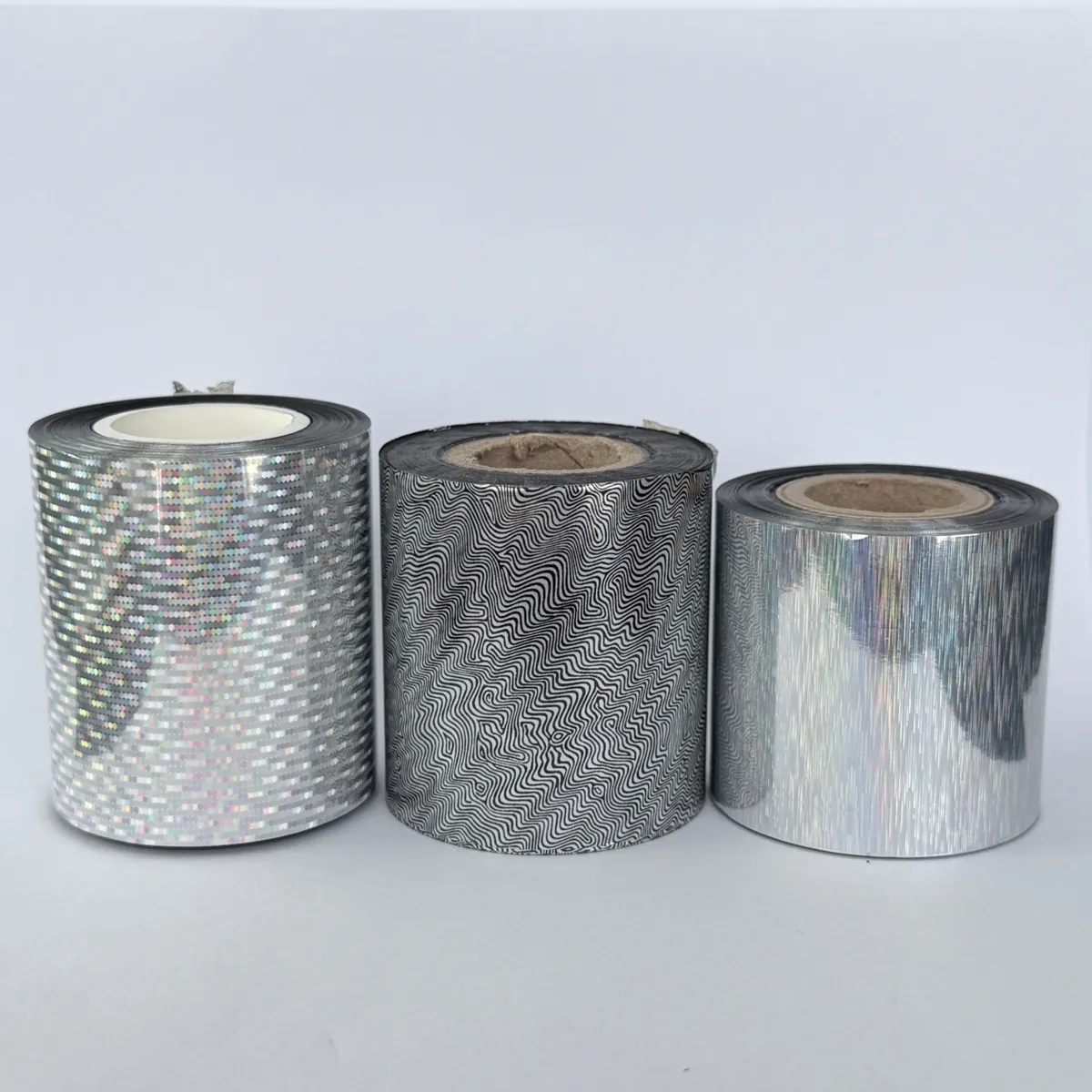
Scratch-Off Foil for Hot Stamping
High-opacity scratch-off foil for lottery tickets, gift cards and security labels — clean removal, no flaking, strong heat-seal bond to paper, cardstock and PVC.
View productRelated Articles
View all
Technical Knowledge · Nov 2, 2026
Automotive Grille & Interior Trim Hot Stamping: Troubleshooting Guide (2026)
How to fix poor adhesion, flaking, blistering, dull chrome and edge lifting when hot stamping ABS, PC/ABS and PP car grilles and interior trim — with a settings chart, defect matrix and durability test checklist.
Technical Knowledge · Oct 18, 2026
Creasing Matrix Selection & Calculation Guide (2026): Formulas, Types and Cracking Fixes
How to size a creasing matrix from board caliper and rule thickness, when to choose PVC, resin, fibre, reverse-bend or coil matrix, and a step-by-step fix list for cracked, weak or off-register creases in die-cutting.
Technical Knowledge · Apr 10, 2026
Self-Adhesive Label Material: A Buyer's Guide
Choose the perfect self-adhesive label material for your product with this comprehensive guide, ensuring durability and optimal performance. Learn what to consider for your labels today.
Ready to source foil stamping and die-cutting from one supplier?
From stamping foils to post-press machines and die-cutting consumables — get factory-direct pricing and free samples.