
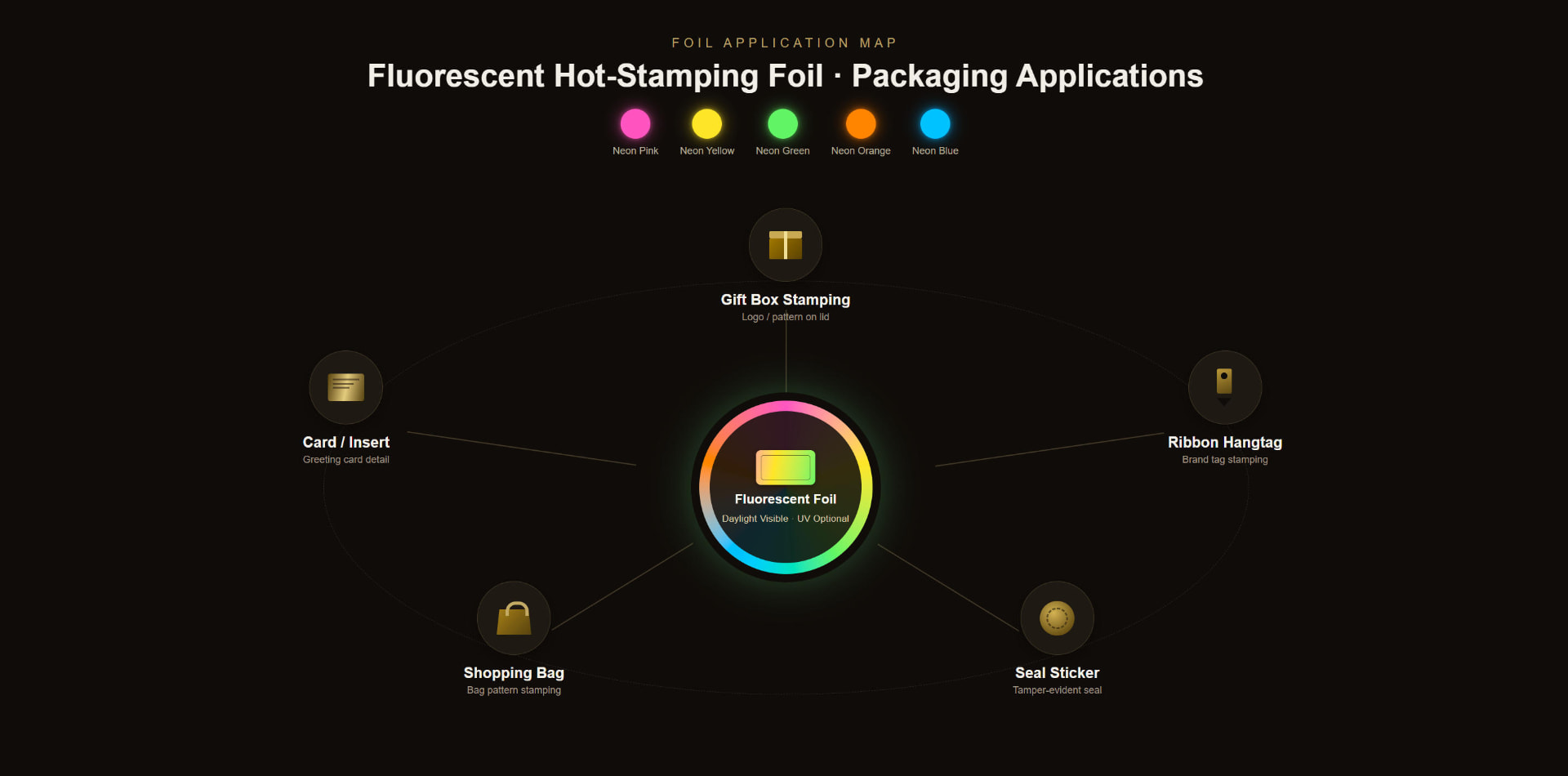
A practical guide to fluorescent hot stamping foil — pigment chemistry, neon and UV-reactive grades, applications, lightfastness limits, and the five things to check before ordering for apparel, packaging or events.
Table of Contents
Most hot stamping foil is chosen to look premium — gold, silver, holographic. Fluorescent hot stamping foil has a different job: get noticed. If your product needs to jump off a crowded shelf, a festival wristband needs to be visible across a dark venue, or a youth apparel label needs neon punch that printed ink cannot deliver, fluorescent foil is the material built for that specific problem.
What makes a foil "fluorescent"?
Standard foils use conventional pigments — metallics, solid colours or pearlescent effects — that reflect light normally. Fluorescent foils use daylight fluorescent pigments, which absorb both visible and a portion of UV light and re-emit it at a longer wavelength. The practical result: the colour looks brighter than physically possible under ordinary light, which is exactly why neon pink or neon yellow foil grabs attention the way a printed equivalent never will.
Select grades go a step further and react under UV/blacklight, glowing visibly in dark or low-light settings — a formulation used heavily in nightlife, festival and cosmetics packaging. For the underlying construction shared by all stamping foils, see our what is hot stamping foil primer, and the fluorescent foil technical guide for full press data.
Where fluorescent foil gets used
- Apparel and footwear branding — heat-transfer logos and hangtags on activewear, streetwear and kids' lines; often paired with textile heat transfer foil.
- Event and festival materials — tickets, wristbands and lanyards that must be spotted quickly, sometimes in low light.
- Retail packaging and POS displays — shelf standout for impulse categories like snacks, beverages and cosmetics.
- Youth and trend-driven goods — stationery, gift wrap and greeting cards aimed at younger buyers.
- Blacklight-reactive cosmetics packaging — a common technique in nightlife-adjacent beauty brands, sometimes layered with holographic foil or security foil.
What to check before you order
- Lightfastness expectations. Fluorescent pigments are inherently less lightfast than metallic or solid-colour pigments — the effect comes from a chemistry that degrades faster under prolonged UV exposure. Fine for a weekend wristband; wrong for a sign in direct sunlight for two years. Ask for expected colour life under your actual use conditions.
- Substrate compatibility. Fluorescent foil performs best on coated paper, cardstock and leather. On plastic or synthetic substrates, confirm adhesion has been tested on that exact material — heat-seal performance varies more with substrate than with colour.
- Colour matching across batches. Fluorescent pigments are more batch-sensitive than standard colours. For brand-critical work, ask whether the supplier can hold shade across repeat runs, or request a retained physical colour standard.
- UV-reactive vs. daylight fluorescent. Not all fluorescent foil glows under blacklight — that is a separate formulation. If your application depends on it, confirm the grade explicitly.
- Press compatibility. Fluorescent foil runs on standard flatbed and rotary presses — including the XG1080G fully automatic hot stamping machine — but confirm roll width and core size before a full production order.
Fluorescent foil vs. standard pigment foil
| Criterion | Fluorescent foil | Standard pigment foil |
|---|---|---|
| Visual intensity | Neon, daylight-bright | Standard solid colour |
| Lightfastness | Lower — best for short/medium-term use | Higher — suited to long-term display |
| Blacklight-reactive option | Available in select grades | Not applicable |
| Typical use case | Apparel, events, retail standout | General branding, long-life packaging |
If you are also weighing decoration methods for the rest of the job, our hot vs cold foil stamping comparison covers the tooling and cost trade-offs.
Sourcing fluorescent hot stamping foil from China
As a hot stamping foil manufacturer exporting to 60+ countries since 2016, All-in Pack (Aifoils) supplies fluorescent foil to apparel brands, packaging converters and event printers. Before ordering a full production run, ask any supplier for:
- A physical sample stamped on your actual substrate — not just a colour chip.
- Written lightfastness guidance for your specific use case.
- Confirmation of whether the grade is UV-reactive, if that matters for your application.
Final thoughts
Fluorescent hot stamping foil solves a visibility problem no other foil type addresses as directly — but it comes with a lightfastness trade-off worth understanding before you commit to a print run. Test on your real substrate, under your real lighting conditions, before scaling up.
See full specifications and request a sample on the Fluorescent Hot Stamping Foil product page, or send us your substrate and press details for a quotation.
Frequently Asked Questions
Quick answers about fluorescent hot stamping foil.
Companion Products
Specs and samples for the products discussed in this article.
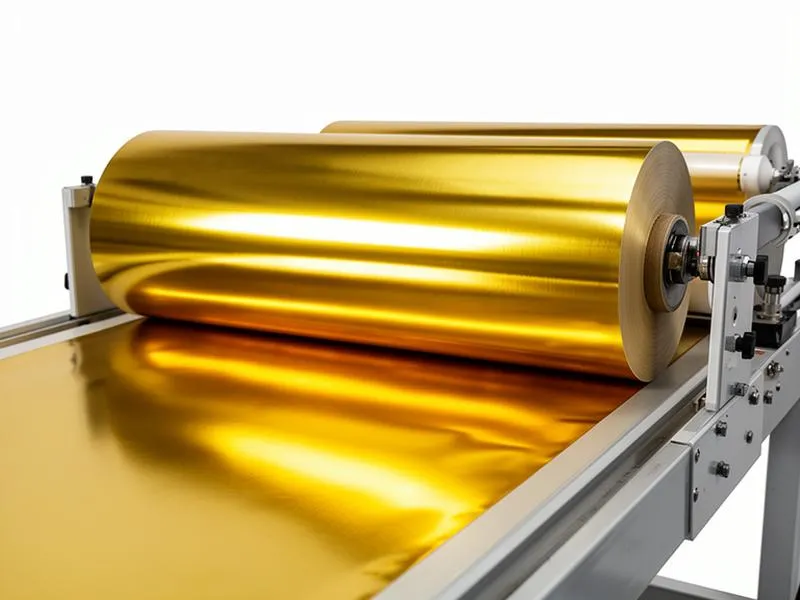
Premium Metallic Gold Hot Stamping Foil
Ultra-bright metallic gold foil with mirror-like reflection for premium packaging and label applications.
View product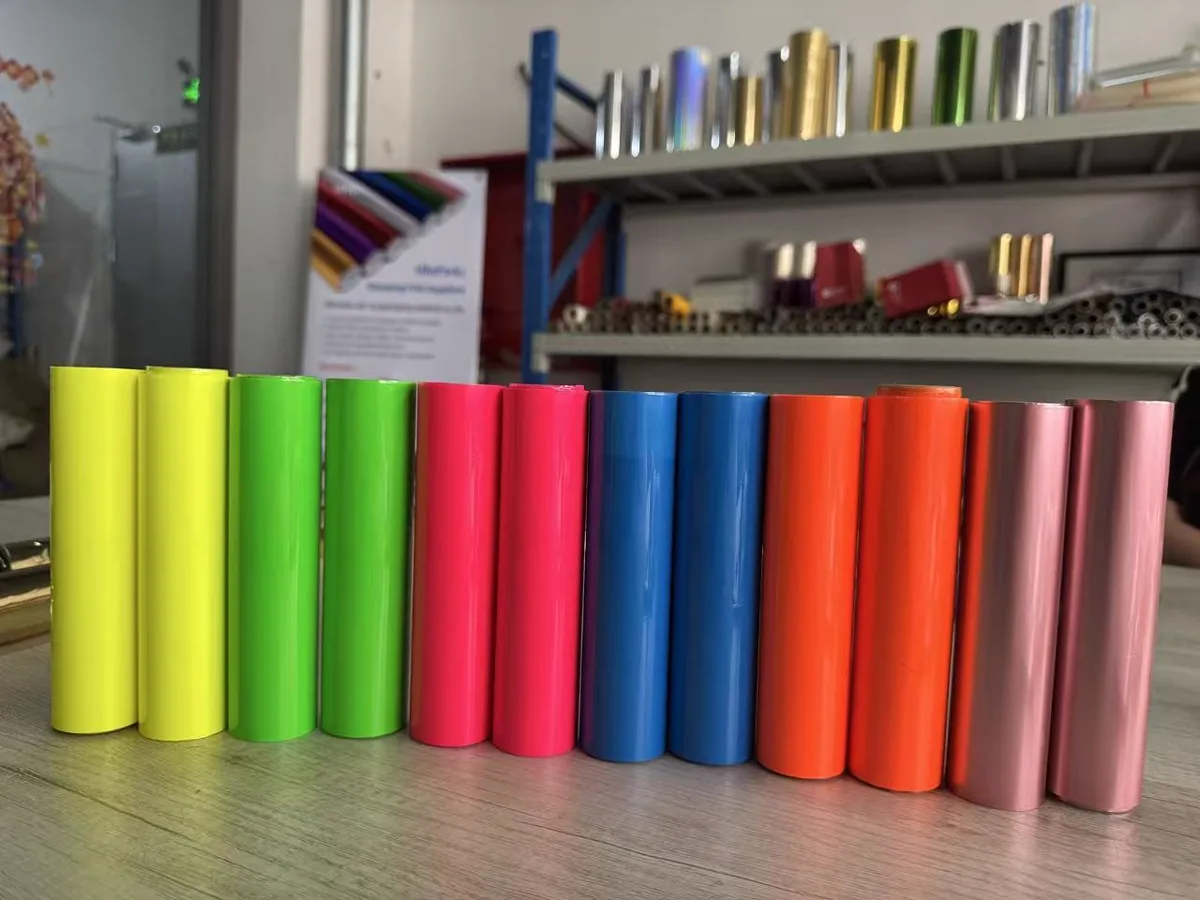
Fluorescent Hot Stamping Foil
High-visibility neon hot stamping foil in pink, yellow, green, orange and blue — daylight-bright fluorescent color with optional UV/blacklight-reactive grades.
View product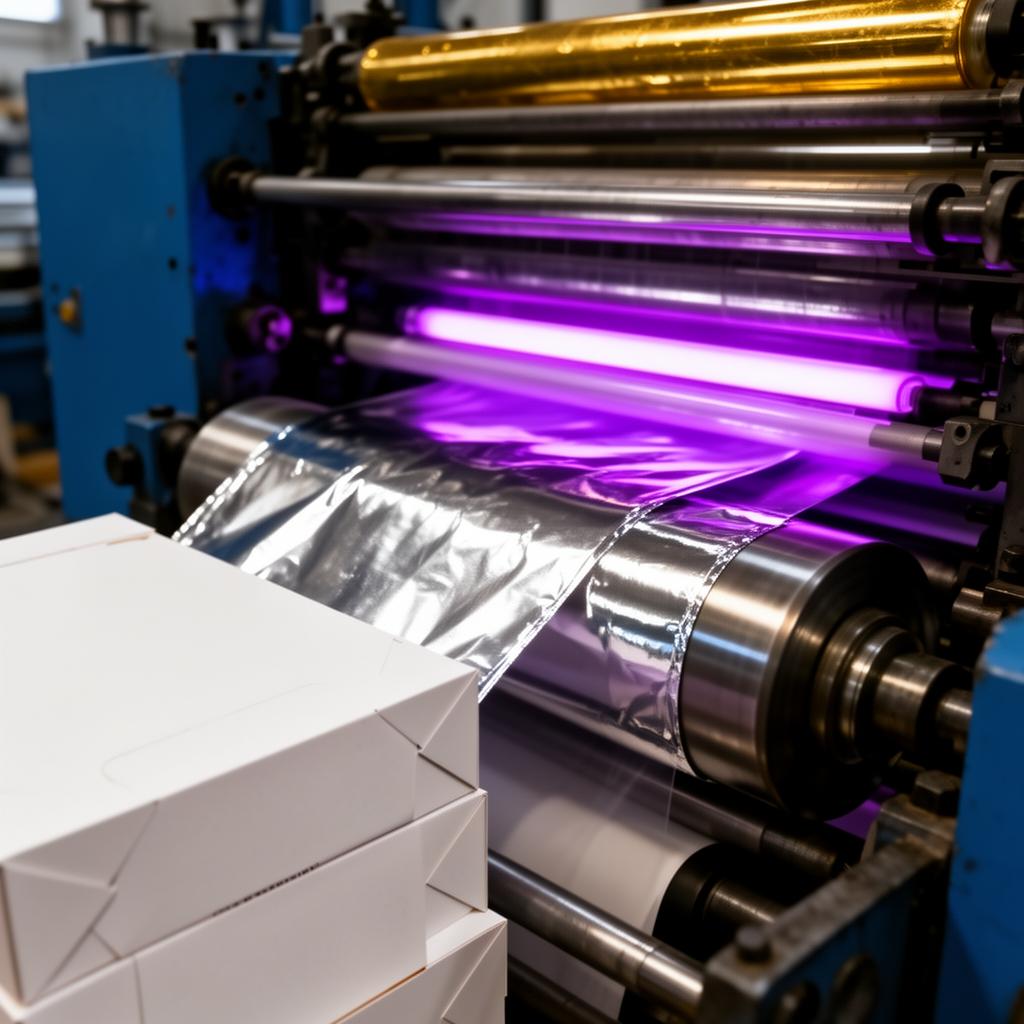
Cold Stamping Foil
Cold stamping foil for inline UV flexo and offset presses — no heat, no dies, up to 150 m/min with metallic, holographic and pigmented finishes.
View productRelated Articles
View allTechnical Knowledge · May 22, 2026
Hot Stamping Foil: PET, Release, Color, Adhesive Layers
Discover the 4 key layers of hot stamping foil: PET carrier, release, color, and adhesive. Understand how each layer works for optimal performance.
Technical Knowledge · May 8, 2026
Hot Stamping Foil for Automotive Interiors Guide
Discover hot stamping foil for automotive interiors. This guide covers materials, specs, and OEM tests for durable car trim and logo decoration.
Technical Knowledge · Apr 20, 2026
Hot Stamping Foil for Paper Packaging: Buyer's Guide
Choose hot stamping foil for paper packaging with confidence. This guide helps buyers match foil to substrates and optimize stamping for luxury cartons.
Ready to source foil stamping and die-cutting from one supplier?
From stamping foils to post-press machines and die-cutting consumables — get factory-direct pricing and free samples.