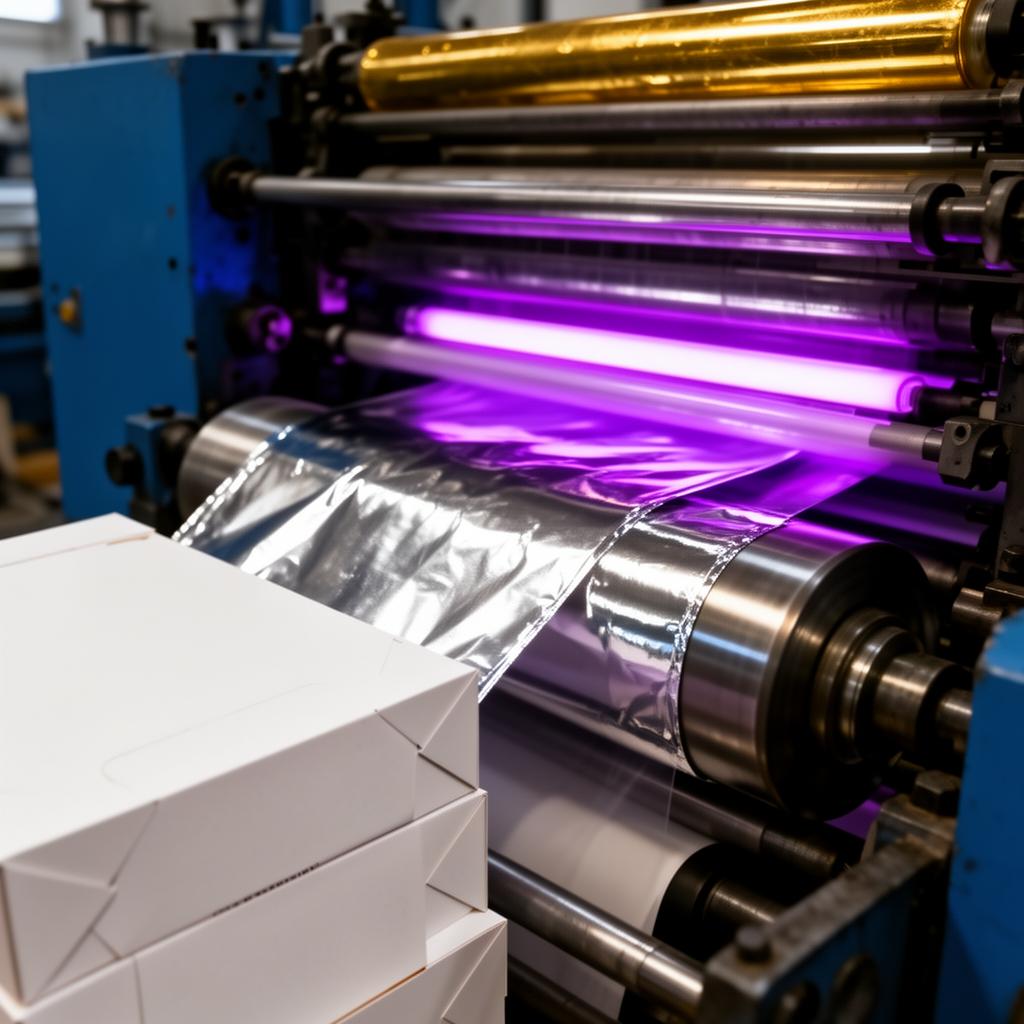
Per-impression cost, setup time, brilliance, substrate flexibility — the five-variable equation that decides whether cold foil or hot foil wins your next job. With breakeven math and worked examples.
Table of Contents
- 1. The Two Technologies in 60 Seconds
- 2. The Five-Variable ROI Equation
- Variable 1 — Setup Cost
- Variable 2 — Production Speed
- Variable 3 — Foil Cost per Impression
- Variable 4 — Visual Quality & Brilliance
- Variable 5 — Substrate Flexibility
- 3. Breakeven Worked Example
- 4. The "Both" Strategy
- 5. Where Digital Foiling Fits
- Conclusion
- Frequently Asked Questions
"Should we run this job hot or cold?" is one of the most consequential questions in the foiling room. The answer changes per job — and getting it wrong costs real money. This 2026 guide breaks down the ROI math behind both processes so you can specify with confidence.
1. The Two Technologies in 60 Seconds
Hot foil stamping uses a heated metal die (≈110–160 °C) to transfer a metallized PET-based foil onto the substrate via heat + pressure. It's a discrete operation, typically post-print on a dedicated press.
Cold foil uses a UV-curable adhesive printed inline on a flexo or offset press, then laminates the foil onto the wet adhesive before UV-curing and peeling away the carrier. No heat, no metal die — just a printing plate.
2. The Five-Variable ROI Equation
Variable 1 — Setup Cost
- Hot foil: Custom magnesium or brass die required (USD 80–400 per die depending on size and detail). Re-orderable but adds lead time on first runs.
- Cold foil: Standard flexo plate (USD 40–150). Same plate-making workflow as the rest of the job — no specialized supplier needed.
Variable 2 — Production Speed
- Hot foil (sheet-fed): 3,000–6,000 sheets/hour on modern automatic presses such as our XG1080G.
- Cold foil (inline): 100–150 m/min on web flexo presses — equivalent to 30,000+ small labels per hour with no separate finishing pass.
Cold foil wins on raw throughput by a wide margin — but only when integrated into a print run that's already happening.
Variable 3 — Foil Cost per Impression
Hot foil typically transfers more efficiently (lower foil-to-area ratio) because the die only delivers foil where needed. Cold foil's inline economics depend on the inline registration accuracy and waste rate. As a rough rule:
- Hot foil: 0.6–0.9× substrate area in foil consumption
- Cold foil: 1.0–1.4× substrate area in foil consumption
Per-impression foil cost is therefore typically 20–40% lower for hot foil — which matters most on long runs.
Variable 4 — Visual Quality & Brilliance
Hot foil delivers higher brilliance, sharper edges and the ability to combine with embossing in a single pass. Cold foil enables CMYK overprinting on top of the foil layer to create custom metallic colors — impossible with hot foil. See our Premium Metallic Gold Hot Stamping Foil versus the Cold Stamping Foil for the substrate-specific tradeoffs.
Independent comparisons by TLMI consistently rate hot foil higher on perceived premium quality — a meaningful factor on cosmetics and spirits packaging.
Variable 5 — Substrate Flexibility
- Hot foil: Works on paper, board, plastic, leather, wood, fabric, even glass with the right adhesive layer.
- Cold foil: Best on smooth, non-porous label stocks. Struggles on textured boards and uncoated papers because the UV adhesive needs a smooth surface to anchor.
3. Breakeven Worked Example
Consider a 50,000-impression job, 100 × 60 mm foil area per piece:
| Cost Component | Hot Foil | Cold Foil |
|---|---|---|
| Setup (die / plate) | $200 | $80 |
| Press time @ $120/hr | $1,200 (10 hr) | $300 (inline) |
| Foil consumption | $540 | $760 |
| Total | $1,940 | $1,140 |
Cold foil wins by ~40% on this medium-volume label run. Now scale the same job to 5,000 impressions and the breakeven flips: hot foil's lower setup-to-output ratio loses on short runs only when the press time differential is small.
The general rule of thumb our application engineers use:
- <10,000 impressions, premium look required: Hot foil
- 10,000–100,000 impressions, label work: Cold foil if you have the inline capability
- >100,000 impressions, complex multi-color or rigid substrate: Hot foil on automatic press
4. The "Both" Strategy
The most successful converters in 2026 don't choose — they offer both. Hot foil for premium short-to-medium runs and combination effects (foil + emboss); cold foil for high-volume label work where the savings compound. This dual capability lets you quote any job profitably.
5. Where Digital Foiling Fits
A third option — digital toner-reactive foiling — is now economically viable for very short runs (<500 impressions) and personalized work. Our Digital Toner-Reactive Foil works on standard digital presses with no dies or plates required. We covered the broader landscape in our earlier cold vs hot foil overview and Drupa 2025 recap.
Conclusion
The cold-vs-hot ROI question doesn't have a universal answer — it has a per-job answer driven by volume, substrate, quality target and existing equipment. Converters who can run the breakeven math in 60 seconds and quote both options confidently will win the most work. Need help benchmarking your current foiling economics? Request a process review with our application engineers, or browse the full stamping foil range.
Frequently Asked Questions
Quick answers about cold foil.
Companion Products
Specs and samples for the products discussed in this article.
Related Articles
View all
Technical Knowledge · Mar 1, 2026
Cold Foil vs Hot Foil Stamping: Which Is Right for Your Packaging?
A detailed comparison of cold foil and hot foil stamping technologies — cost, speed, quality, and best-use scenarios for modern packaging production.
Technical Knowledge · Apr 21, 2026
Hot Foil vs Cold Foil vs Digital Foil: Which Foiling Method Wins in 2026?
Hot stamping, cold foil and digital foil all deliver a metallic finish — but the economics, substrate freedom and minimum order size are completely different. Here is a side-by-side decision framework for packaging buyers and converters in 2026.
Technical Knowledge · Apr 10, 2026
How to Choose the Right Self-Adhesive Label Material: A 2026 Buyer's Guide for Converters & Brand Owners
Facestock, adhesive, liner — the three layers that decide whether your label survives the cold chain, the wash cycle, or the next decade. A practical 2026 guide to specifying self-adhesive label materials.
Ready to source from a true Packaging Resource Integrator?
From stamping foils to self-adhesive materials and post-press equipment — get factory-direct pricing and free samples.