
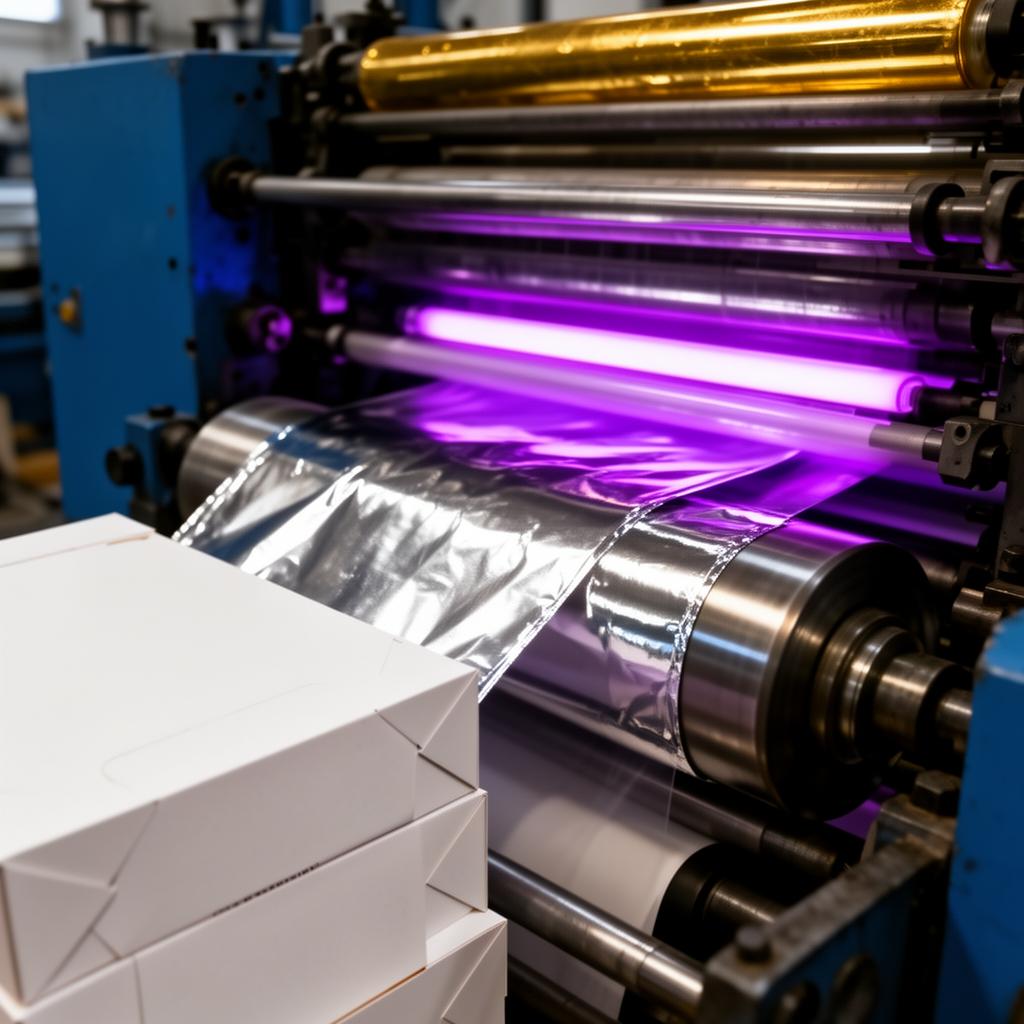
Compare cold foil vs hot foil for high-speed printing. Discover technical details to choose the best stamping foil for your packaging needs.
Table of Contents
- The Technical Mechanics: Heat vs. Adhesive Bonding
- Performance Comparison Table
- Why Choose Hot Foil Stamping?
- The Advantages of Inline Cold Foil
- 1. High-Speed Throughput
- 2. Complex Gradients and Fine Detail
- 3. Over-Printing for Infinite Metallic Colors
- Substrate Limitations and Pre-treatment
- Cost Analysis: Tooling vs. Material Waste
- Conclusion: Which is Better?
- Specify Your Project
- Frequently Asked Questions
Choosing between cold foil vs hot foil remains a pivotal decision for packaging engineers and label converters seeking the optimal balance of aesthetic brilliance and production throughput. While hot stamping has long been the gold standard for luxury finishes, the rise of high-speed rotary presses and UV-curable adhesives has positioned inline cold foil as a formidable competitor for high-volume jobs. The choice depends on more than just "look"; it involves technical variables such as substrate porosity, press speed (m/min), and compatibility with subsequent ink layers. This technical deep dive examines the mechanical differences, substrate requirements, and cost-benefit ratios of both technologies to help you specify the right material for your next run.
The Technical Mechanics: Heat vs. Adhesive Bonding
The primary distinction between cold foil and hot foil lies in how the decorative layer—typically a 12-micron to 16-micron polyester carrier—is transferred to the substrate. Hot stamping is a relief printing process. It requires a heated metal die (magnesium, copper, or brass) and pressure. When the die hits the premium metallic gold hot stamping foil, it melts a heat-activated release layer and an adhesive layer, fusing the aluminum to the paper or film.
Conversely, cold foil is a planographic process. Instead of heat, it uses a UV-curable adhesive. The adhesive is printed onto the substrate like an ink using a standard printing plate. The cold stamping foil is then nipped against the substrate; it sticks only where the adhesive was applied. A UV lamp then cures the adhesive through the foil or the substrate to finalize the bond.
Performance Comparison Table
To understand the operational ceiling of each method, we must look at the specific physical parameters under which they operate most efficiently.
| Feature | Hot Foil Stamping | Cold Foil (Inline) |
|---|---|---|
| Production Speed | 50 - 120 m/min (Rotary); 2,500 - 5,000 sph (Flatbed) | up to 150 - 180 m/min |
| Application Temp | 100°C - 150°C (depending on substrate) | Ambient (UV Curing) |
| Substrate Compatibility | Coated/Uncoated Paper, Leather, Plastic | Non-porous/Smooth surfaces (BOPP, PET, Coated Paper) |
| Tooling Requirement | Metal Die (Magnesium/Brass/Copper) | Standard Flexo or Offset Plate |
| Halftone Capabilities | Limited (Difficult to achieve fine gradients) | High (Excellent for fine lines and vignettes) |
| Over-printability | High (Excellent ink adhesion) | Moderate to High (Requires specific foil surface tension) |
Why Choose Hot Foil Stamping?
Hot stamping remains the preferred choice for premium "look and feel." Because the process involves physical pressure, it often creates a slight debossing effect that adds tactile value. For heavy-duty packaging, machines like the XG1080G fully automatic hot stamping machine provide the kgf/cm² pressure necessary to reach deep into the fibers of luxury uncoated stocks.
- Unparalleled Brilliance: Hot foils generally offer a more "mirror-like" finish due to the smoothness of the heat-activated release.
- Substrate Versatility: Because the adhesive is pre-applied to the foil and activated by heat, it can bridge the gaps in textured papers or matte white self-adhesive label paper.
- Deep Embossing: Only hot stamping allows for a single-pass foil and emboss (fluted die), which is essential for high-end wine and spirit labels.
The Advantages of Inline Cold Foil
For high-speed, high-volume label production, cold foil is frequently the more economical and efficient choice. Since the process happens inline on a 10-unit flexo or offset press, there is no need for a secondary pass, significantly reducing labor costs.
1. High-Speed Throughput
While a flatbed stamping machine might top out at 5,000 sheets per hour, a cold foil setup can keep pace with the primary press at speeds exceeding 150 m/min. This is particularly effective when working with transparent BOPP self-adhesive film, where the smoothness of the film facilitates a perfect bond via UV flexo cold foil adhesive.
2. Complex Gradients and Fine Detail
Because cold foil uses a photographic printing plate rather than a CNC-machined die, it can reproduce extremely fine screens (up to 175 lpi) and vignettes. To learn more about this process, see our step-by-step cold foiling guide.
3. Over-Printing for Infinite Metallic Colors
One of the strongest arguments for cold foil is the ability to print "over" the foil. By applying a silver foil and then printing CMYK process colors on top of it, converters can create a full spectrum of metallic hues without purchasing separate colored foils. This is a common tactic for high-speed beverage labeling.
Substrate Limitations and Pre-treatment
A critical technical factor in "cold foil vs hot foil" is the substrate surface energy. Cold foil depends entirely on the adhesive "wetting out" on the surface. On porous papers, the adhesive is absorbed into the fibers before the foil can be nipped, leading to poor transfer. For these applications, a primer or a high-quality synthetic PP label material is recommended to keep the adhesive on the surface.
Hot foiling is more forgiving of surface quality but requires a substrate that can withstand the 130°C temperature of the die without warping or melting. For thermal-sensitive materials, such as thermal direct self-adhesive label stock, traditional hot stamping is often impossible as the heat will blacken the thermal layer, making cold foil or digital foil the only viable options.
Cost Analysis: Tooling vs. Material Waste
The "total cost of ownership" for a project hinges on run length.
- Tooling: Cold foil uses standard plates (approx. $50-$150), whereas hot stamping dies can cost $300-$1,500 depending on complexity and metal type.
- Setup Time: Cold foil setups take minutes on an existing press line. Hot stamping requires die mounting, leveling, and heating, which can take 1-2 hours.
- Waste: Hot stamping is more efficient with foil usage because the foil only moves when the die hits (intermittent feeding). Cold foil moves at the same speed as the web, leading to higher foil waste if the design is sparse. Foil saving systems on modern presses can mitigate this, but it remains a consideration.
Conclusion: Which is Better?
If your project demands the highest possible luster, tactile depth, or is printed on textured paper, Hot Foil Stamping is the winner. If your priority is 150 m/min production speeds, fine-screen halftone metallic effects, or multi-color metallic gradients on filmic labels, Cold Foil Stamping is superior. For many modern shops, maintaining both capabilities—an XG1080G machine for premium sheets and a cold foil unit on their flexo line—provides the necessary flexibility to serve the widest client base.
Specify Your Project
Are you looking to upgrade your finishing department or source high-tensile foil for a high-speed run? Our engineers can help you match the correct adhesive and carrier thickness for your specific press. Contact All-in Pack today to request a technical spec sheet or a sample roll of our latest 12-micron decorative foils.
Frequently Asked Questions
Quick answers about stamping-foil.
Companion Products
Specs and samples for the products discussed in this article.
Related Articles
View all
Technical Knowledge · May 12, 2026
Pigment Hot Stamping Foil: Solid Color Effects
Achieve 100% opaque, solid color effects with pigment hot stamping foil. Elevate your packaging with high-gloss or matte finishes for superior results.
Technical Knowledge · Apr 21, 2026
Hot Foil vs Cold Foil vs Digital Foil: 2026 Comparison
Compare hot foil, cold foil, and digital foil to find the best foiling method for your packaging needs. This guide offers insights on metallic finishes.
Technical Knowledge · Aug 25, 2026
Foil Stamping vs Digital Foil vs Cold Foil: Which Method Actually Wins on Cost?
An honest four-part cost comparison of hot foil stamping, cold foil and digital foil — tooling, material, machine time and changeover — plus the run-length crossover points, substrate limits and lower-cost alternatives to foil altogether.
Ready to source foil stamping and die-cutting from one supplier?
From stamping foils to post-press machines and die-cutting consumables — get factory-direct pricing and free samples.