
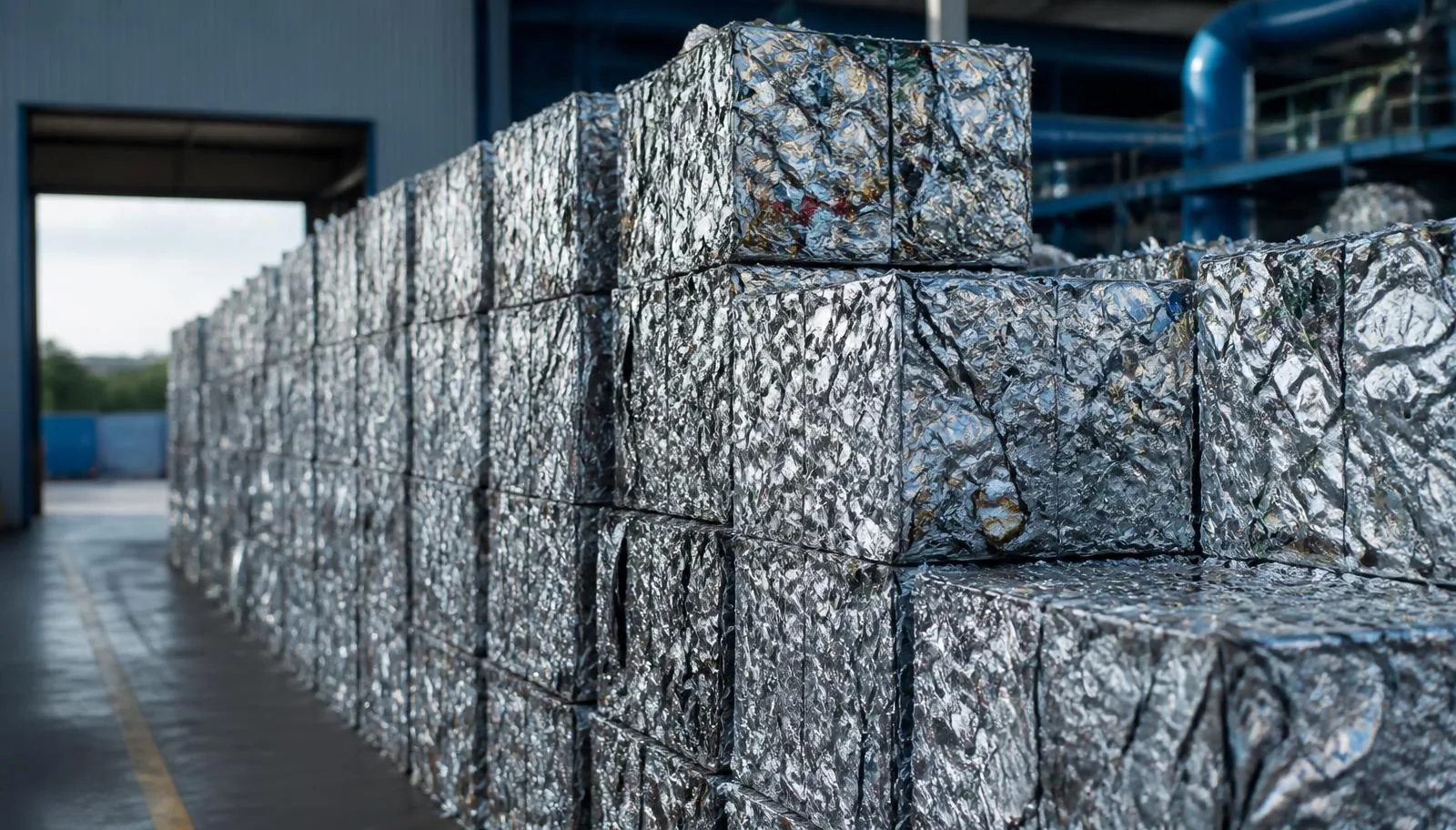
How the 30-50 nm aluminium layer in stamping foil behaves in paper repulping, PP and PE streams — with de-metallisation chemistry, PTS-RH 021 and INGEDE 11 test protocols, PPWR/EPR obligations, closed-loop scrap recovery economics and a supplier audit checklist.
Table of Contents
- 1. Two Very Different Aluminium Streams
- 2. What Happens in the Paper Repulping Stream
- 3. De-Metallisation Chemistry in Plain Terms
- 4. Test Protocols That Produce Defensible Evidence
- 5. Polymer Streams: PP, PE and Mono-Material Packs
- 6. Closed-Loop Recovery of Spent Foil Scrap
- 7. Compliance Map: What You Must Be Able to Prove
- 8. Supplier Audit Checklist
- 9. A Realistic Migration Path
- Conclusion
- Frequently Asked Questions
Aluminium is the most recycled packaging metal on earth — recycling it uses about 5% of the energy needed for primary smelting, and the metal can be re-melted indefinitely without losing properties. Yet the aluminium inside a decorated carton behaves nothing like an aluminium can. In a hot stamping foil the metal layer is only 30-50 nanometres thick, bonded to lacquers and adhesives, and carried on a PET film that never reaches the customer. Whether that decoration helps or harms recyclability depends entirely on how it is engineered.
This guide is written for brand owners, packaging engineers and converters who have to defend a recyclability claim in a PPWR audit, an EPR fee calculation or a retailer scorecard. It covers what actually happens to metallised decoration in each recycling stream, which laboratory protocols produce defensible evidence, and how to recover value from spent foil scrap inside your own plant.
1. Two Very Different Aluminium Streams
Confusion in this field almost always comes from mixing up two things that both get called "foil".
- Metal-stream aluminium — household foil, trays, blister lidding, laminated pouches. Thickness 6-200 µm. Recovered mechanically or by pyrolysis, re-melted into secondary ingot. Recovery rates above 70% in the EU.
- Decorative metallised layers — the vacuum-deposited aluminium in hot stamping foil, cold foil and metallised films. Thickness 30-50 nm, which is roughly 0.1 g of aluminium per square metre of decorated surface. There is no economic case for recovering this metal from the finished pack; the objective is that it must not contaminate the fibre or polymer stream it travels in.
A single premium carton can contain both: a metallised inner liner (metal or polymer stream) and a stamped logo (fibre stream). They must be assessed separately.
2. What Happens in the Paper Repulping Stream
Roughly 80% of foil-decorated packaging is board that goes into the recovered-paper stream. Repulping runs at 40-55 °C in an alkaline, high-shear slurry. Three outcomes are possible:
- Clean detachment. The release and size-press layers of a de-metallisable foil hydrolyse, the aluminium film breaks into fragments larger than 0.1 mm and is removed at the coarse and fine screens. Fibre yield is unaffected. This is the target behaviour.
- Fragmentation into specks. A conventional decorative foil with a strongly crosslinked adhesive shatters into sub-100 µm flakes that pass the screens and reappear as visible glitter in the recycled sheet. Mills reject these loads or downgrade them.
- Sticky rejects. UV-cure acrylate adhesives from older cold-foil systems soften and agglomerate on rolls and screens. This is the failure mode mills complain about most, because it costs downtime rather than just quality.
Coverage matters as much as chemistry. Below roughly 5% of the panel area, almost any foil passes. Between 5% and 25% the adhesive system decides the result. Above about 40% coverage the pack is effectively a metallised laminate and should be declared as such. Our recyclable hot stamping foil guide sets out the coverage bands and de-inking behaviour in more detail.
3. De-Metallisation Chemistry in Plain Terms
A recyclable decorative foil is engineered so that a defined layer fails on purpose during repulping. Three mechanisms are in commercial use:
| Mechanism | How it releases | Best suited to | Trade-off |
|---|---|---|---|
| Alkali-sensitive primer | Primer saponifies at pH 10-11, the metal sheet lifts off in flakes | Hot stamping on coated board | Needs controlled press dwell so the primer is not over-cured |
| Water-dispersible adhesive | Adhesive swells and dissolves, releasing metal and lacquer together | Cold foil, inline flexo and offset | Lower humidity tolerance in tropical warehousing |
| Weak-boundary lacquer | A deliberately low-cohesion colour lacquer shears under turbulence | Large solid areas, high coverage | Slightly reduced scuff resistance without an overprint varnish |
None of these mechanisms changes how the job looks on shelf. What changes is the press window: recyclable grades typically want 5-10 °C lower stamping temperature and 10-15% shorter dwell than a conventional grade. On a modern servo press such as the XG1080G automatic hot stamping machine that is a recipe change, not a hardware change.
4. Test Protocols That Produce Defensible Evidence
A supplier statement is not evidence. Auditors and mills accept laboratory results against published methods:
- PTS-RH 021 (Papiertechnische Stiftung) — the reference repulpability method in Europe for paper packaging. Reports fibre yield, screen rejects and visual dirt count.
- INGEDE Method 11 — de-inkability of printed and decorated paper. Produces a scored de-inkability value; foil-stamped areas are assessed for residual specks and luminosity loss.
- CEPI Recyclability Laboratory Test — the harmonised European method now referenced by most PPWR readiness programmes and retailer scorecards. See CEPI.
- 4evergreen Circularity by Design — design guidance rather than a test, but retailers increasingly ask which category your pack falls into.
- ISO 14067 product carbon footprint — for the foil itself, per kilogram or per square metre, not a generic industry average.
Ask for the full report, not a certificate page: the screen-reject fraction and the dirt-speck area are the two numbers a mill will actually look at.
5. Polymer Streams: PP, PE and Mono-Material Packs
For pouches, sleeves and labels the question is different — the aluminium must not disturb the polymer melt or the near-infrared sorting step. Practical rules:
- Keep the decoration and the substrate in one polymer family. A mono-PP pouch decorated with a PP-compatible cold foil stays sortable; the same pouch with a PET-based decoration is downgraded.
- Metallised layers are effectively invisible to NIR sorters at 30-50 nm, but a continuous metallised barrier film of 8-12 µm is not — it reads as a reject.
- Wash-off decoration solves the sleeve problem: on PET bottles a caustic-wash-releasable label or washable metallic foil leaves the flake stream clean, which is what recyclers pay a premium for.
- Adhesive choice governs the outcome more than the metal. Water-based and hot-melt systems designed for the caustic wash are available for most self-adhesive label materials.
6. Closed-Loop Recovery of Spent Foil Scrap
The largest aluminium mass in a foil-stamping plant is not on the packaging — it is on the used ribbon rolls in the waste bay. A converter running one 1080 mm press for two shifts consumes roughly 12-20 tonnes of foil ribbon a year. That waste is around 90% PET carrier by mass, with recoverable aluminium and residual lacquer.
Three routes exist, in descending order of value:
- Supplier take-back. Segregated ribbon cores and rolls returned in the inbound logistics loop. Zero landfill fee, documented recovery rate for the ESG report.
- PET carrier reclamation. Specialist processors de-laminate the carrier and re-pelletise it for non-food applications. Requires clean segregation — no mixed plastics, no tape.
- Pyrolysis with metal recovery. The polymer fraction becomes fuel gas and the aluminium and oxide fraction is recovered as a concentrate. Economic only above a few hundred tonnes a year, so regional aggregation is normal.
The prerequisite in every case is segregation at the press. A single bin for foil ribbon next to the machine typically moves 85-95% of the stream out of general waste in the first month, and it is the cheapest sustainability KPI a converter can report.
7. Compliance Map: What You Must Be Able to Prove
| Requirement | Applies to | Evidence to hold on file |
|---|---|---|
| PPWR "recyclable by design" | All packaging placed on the EU market | CEPI or PTS repulpability report per decorated construction |
| EPR modulated fees | Producers and importers, per country scheme | Material breakdown by mass, including decoration coverage |
| Green-claims substantiation | Any "recyclable" or "bio-based" wording | Test report plus ISCC PLUS or REDcert2 chain-of-custody |
| Food-contact and migration | Primary packaging | Framework Regulation 1935/2004 declaration from the foil maker |
| Scope 3 carbon reporting | Brand owners with SBTi targets | ISO 14067 PCF per kg of foil, supplier-specific |
8. Supplier Audit Checklist
- Repulpability report against PTS-RH 021 or the CEPI method, dated within 24 months, for the exact grade you buy.
- Stated coverage limit at which the claim remains valid, expressed as a percentage of panel area.
- Adhesive family disclosed: solvent, water-based, hot-melt or UV — and its behaviour in an alkaline wash.
- Product carbon footprint per ISO 14067, supplier-specific rather than sector average.
- Documented take-back or recovery route for spent ribbon, with a recovery rate you can quote.
- REACH SVHC and, for skin-contact goods, OEKO-TEX documentation.
- Retained batch samples so a recyclability claim can be re-tested against the material actually shipped.
9. A Realistic Migration Path
Most brands do not need to redesign the pack. A staged route delivers the majority of the benefit in one sourcing cycle:
- Inventory every decorated SKU and record foil type, coverage percentage and substrate.
- Move the high-coverage SKUs first — they carry the compliance risk and the highest EPR fee exposure.
- Qualify a de-metallisable grade on a single press with a documented recipe, then roll the recipe out.
- Commission a repulpability test on the finished decorated pack, not on the bare foil.
- Set up ribbon segregation and a take-back agreement in parallel — it needs no artwork change and reports immediately.
For the broader material landscape, including PET-free carriers and bio-based digital grades, see our companion article on sustainable stamping foil trends.
Conclusion
Aluminium decoration and circular packaging are not in conflict. The metal load is tiny; what determines the recycling outcome is the release chemistry, the coverage and the evidence you can produce. Specify a de-metallisable grade, hold a current repulpability report, keep decoration and substrate in one material family, and close the loop on your ribbon scrap — and a foil-stamped pack passes the same audits as an undecorated one.
Send us your substrate, coverage and press details and we will recommend a recyclable grade with the matching test documentation: request a technical consultation or browse the full stamping foil range.
Frequently Asked Questions
Quick answers about aluminium foil recycling.
Companion Products
Specs and samples for the products discussed in this article.
Premium Metallic Gold Hot Stamping Foil
Ultra-bright metallic gold foil with mirror-like reflection for premium packaging and label applications.
View product
Cold Stamping Foil
Cold stamping foil for inline UV flexo and offset presses — no heat, no dies, up to 150 m/min with metallic, holographic and pigmented finishes.
View product
Scratch-Off Foil for Hot Stamping
High-opacity scratch-off foil for lottery tickets, gift cards and security labels — clean removal, no flaking, strong heat-seal bond to paper, cardstock and PVC.
View productRelated Articles
View all
Technical Knowledge · Apr 10, 2026
Self-Adhesive Label Material: A Buyer's Guide
Choose the perfect self-adhesive label material for your product with this comprehensive guide, ensuring durability and optimal performance. Learn what to consider for your labels today.
Technical Knowledge · Apr 20, 2026
Hot Stamping Foil for Paper Packaging: Buyer's Guide
Choose hot stamping foil for paper packaging with confidence. This guide helps buyers match foil to substrates and optimize stamping for luxury cartons.
Technical Knowledge · Aug 25, 2026
Holographic Foil Printing: The Complete Technical Guide (2026)
How holographic foil printing actually works — hot stamping, cold foil and transfer sheets compared, the four holographic foil families, security OVD requirements, honest limitations, and a step-by-step way to choose the right method for your run length.
Ready to source foil stamping and die-cutting from one supplier?
From stamping foils to post-press machines and die-cutting consumables — get factory-direct pricing and free samples.