
Explore the growth of holographic foil in luxury packaging and anti-counterfeit applications. Learn how it protects brands and boosts aesthetic appeal.
Table of Contents
- 1. Why Holographic Foil Is Trending in 2026
- 2. Five High-Growth Application Segments
- 2.1 Cosmetics & Personal Care
- 2.2 Spirits, Wine & Premium Beverages
- 2.3 Pharmaceutical Anti-Counterfeit
- 2.4 Tobacco, Vaping & Regulated Products
- 2.5 Greeting Cards, Stationery & Gifts
- 3. Choosing the Right Holographic Pattern
- 4. Production Considerations for Converters
- 5. The Sustainability Question
- Conclusion
- Frequently Asked Questions
Holographic foil has moved beyond novelty stickers into one of the most strategic finishing categories of 2026. According to Research and Markets, the global holographic foil market is forecast to grow at a high single-digit CAGR through 2030, driven by two converging trends: the explosion of premium packaging and the urgent need for brand-protection technologies.
1. Why Holographic Foil Is Trending in 2026
Three forces are reshaping demand:
- Brand protection regulation: WHO estimates 1 in 10 medical products in low/middle-income countries is counterfeit. New EU FMD and US DSCSA serialization rules push brand owners toward overt+covert visual authentication — exactly what holographic foil delivers.
- Premiumization of consumer goods: Cosmetics, spirits, and confectionery brands are using holographic effects to justify higher shelf prices and create "shareable" unboxing moments on TikTok & Instagram.
- Sustainability-compatible decoration: Modern holographic foils transfer only a 1–2 µm metallized layer onto paper substrates that remain recyclable in standard pulp streams — unlike full metallized films.
2. Five High-Growth Application Segments
2.1 Cosmetics & Personal Care
Holographic rainbow effects on lipstick cartons, perfume folding boxes, and skincare cartons signal premium positioning. Iridescent patterns shift color under store lighting — a critical "stop-the-shopper" moment in crowded beauty aisles. Our Holographic Rainbow Foil is the workhorse for this segment.
2.2 Spirits, Wine & Premium Beverages
Whiskey labels, champagne neck-foils and tequila cartons now routinely combine holographic stamping with embossing for tactile depth. The combination is difficult to replicate — a deliberate counterfeiting deterrent for high-margin SKUs.
2.3 Pharmaceutical Anti-Counterfeit
Custom-pattern holograms (logos, micro-text, kinetic effects) function as overt authentication on blister packs and outer cartons. When paired with QR-code serialization, they form the visual layer of a multi-factor brand-protection stack. See our Anti-Counterfeit Security Foil for production details.
2.4 Tobacco, Vaping & Regulated Products
Despite category restrictions, regulated products rely heavily on holographic seals as tax-stamp and authenticity markers. Many national tax authorities specify holographic features in their official stamp specifications.
2.5 Greeting Cards, Stationery & Gifts
Holographic foil drives impulse purchase at retail. Card publishers report 20–40% higher sell-through rates on foiled SKUs versus plain-print equivalents.
3. Choosing the Right Holographic Pattern
Holographic foils fall into three optical families:
- Generic / stock patterns: Rainbow, sparkle, dot-matrix — available off-the-shelf, lowest cost, ideal for decorative work.
- Custom holograms: Brand-owned 2D/3D images recorded on a master shim. High setup cost (USD 3–8k per master) but exclusive to one brand — the gold standard for anti-counterfeit.
- Kinetic / animated effects: Patterns that appear to move when tilted (Pixelgram, Stereogram). Highest difficulty to replicate, used on currency, passports and tax stamps.
The International Hologram Manufacturers Association (IHMA) publishes guidelines on selecting hologram complexity proportional to brand risk.
4. Production Considerations for Converters
- Substrate compatibility: Holographic foils stamp best on coated paper (≥150 gsm) and rigid plastics. Uncoated stocks scatter the diffraction effect.
- Die temperature: Typically 100–130 °C — slightly lower than metallic foils to avoid distorting the embossed micro-pattern.
- Pressure: Even pressure across the die is critical; uneven contact creates "blank" spots in the holographic pattern.
- Combination effects: Pair with embossing (in the same pass on equipment like our XG1080G Automatic Stamping Machine) for maximum tactile-visual impact.
5. The Sustainability Question
Holographic foil's metallized layer is so thin (≈40 nm aluminum) that it doesn't disrupt paper recycling — a meaningful advantage over fully metallized films. Pair holographic stamping with FSC-certified paper substrates for a credible "premium + recyclable" claim. For broader context, see our 2026 sustainable label materials guide.
Conclusion
Holographic foil sits at the intersection of three of the largest packaging trends of 2026: premiumization, brand protection, and sustainable decoration. Converters who invest in modern hot-stamping presses and qualify a range of stock + custom holographic patterns will capture the high-margin work that defines the next five years of decorative finishing. Browse our complete stamping foil range, or request holographic samples to evaluate on your substrate.
Frequently Asked Questions
Quick answers about holographic foil.
Companion Products
Specs and samples for the products discussed in this article.
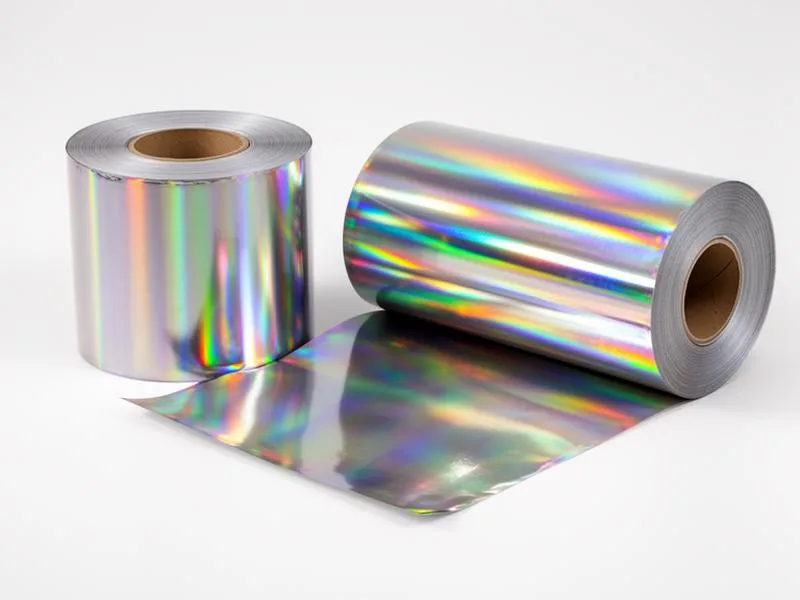
Holographic Rainbow Foil
Rainbow holographic foil with multi-dimensional laser patterns — 15 µm PET, 30–640 mm widths, stamps at 110–140 °C for security and premium packaging.
View product
Anti-Counterfeit Security Foil
Security foil with micro-text, color-shifting OVD, VOID tamper-evidence and custom holograms for pharma, tobacco, electronics and luxury authentication.
View productRelated Articles
View allTechnical Knowledge · Aug 25, 2026
Holographic Foil Printing: The Complete Technical Guide (2026)
How holographic foil printing actually works — hot stamping, cold foil and transfer sheets compared, the four holographic foil families, security OVD requirements, honest limitations, and a step-by-step way to choose the right method for your run length.

Industry News · Aug 24, 2026
Cold Foil Global Market Analysis 2026: What the Numbers Don't Tell You
A supplier-side read of the global cold foil market in 2026: market size, end-use verticals, regional demand, equipment concentration and where the segment is actually heading — with the confidence levels stated honestly.
Industry News · Apr 15, 2026
Sustainable Self-Adhesive Labels: 2026 Eco-Friendly Trends
Explore the future of sustainable self-adhesive labels for 2026, featuring recyclable liners, FSC paper, and wash-off adhesives for eco-conscious brands.
Ready to source foil stamping and die-cutting from one supplier?
From stamping foils to post-press machines and die-cutting consumables — get factory-direct pricing and free samples.