
What Is Cold Foil?
The 60-second definition, the 5-step press process, and the cost vs hot foil — everything you need before sourcing cold foil rolls.
Reviewed by Gavin Gao, Technical Director
Cold foil — definition
Cold foil is a printing process that transfers an aluminium-coated PET film onto a substrate using UV-cured adhesive at room temperature — no heated die, no second pass. It runs inline on flexo or offset presses at 150–400 m/min and is the most cost-efficient way to add metallic gold, silver, or holographic finishes to high-volume labels and folding cartons.
Key Takeaways
- Cold foil bonds aluminium-coated PET to a substrate with UV-cured adhesive — no heated die, no second pass.
- Runs inline on flexo and offset presses at 150–400 m/min — 3-10x faster than hot foil at 20–80 m/min.
- Tooling: cold foil uses an $80–180 print plate, vs $200–500 engraved die for hot foil.
- Silver cold foil + inline CMYK overprint = unlimited custom metallics (gold, copper, rose, rainbow).
- Best for high-volume coated paper, board and label film — 5,000+ unit runs.
- Per-unit cost at 50k units: $0.008–$0.025 cold foil vs $0.015–$0.045 hot foil.
How cold foil works — 5 steps
- Print UV adhesive. A flexo or offset print unit lays down a UV-curable adhesive in the exact shape of the metallic image — like printing ink, only invisible.
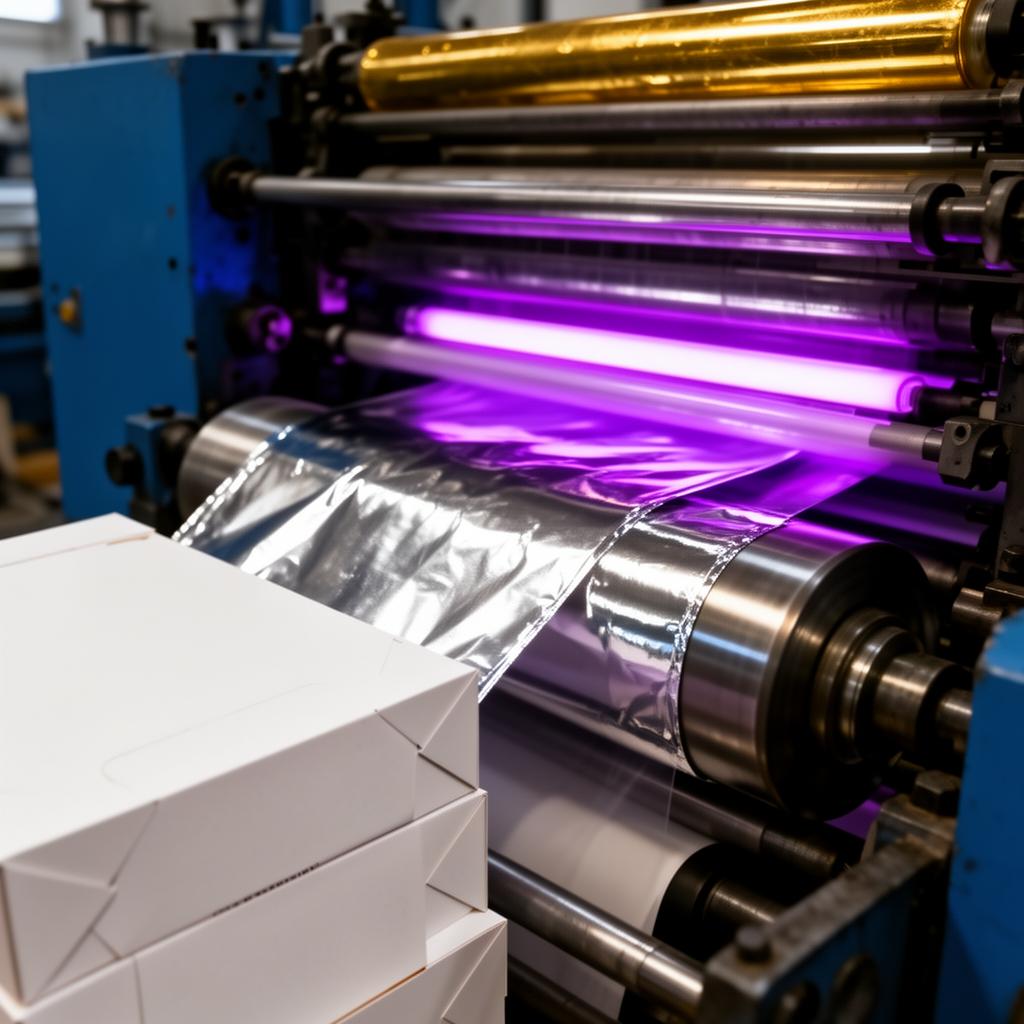
- Laminate the foil web. An aluminium-coated PET foil web is pressed against the wet adhesive at the foil nip, instantly transferring the metallic layer onto the printed adhesive areas.
- UV cure. A UV lamp cures the adhesive within milliseconds, locking the metallic layer to the substrate permanently.
- Strip the carrier. The PET carrier film is peeled off and rewound — only the metallic layer where adhesive was printed remains on the substrate.
- Overprint (optional). Downstream CMYK stations overprint the metallic surface to create unlimited metallic colours (rose gold, copper, bronze) from a single silver foil grade.
Cold foil vs hot foil — quick comparison
| Attribute | Cold Foil | Hot Foil |
|---|---|---|
| Temperature | Room temp | ~120 °C heated die |
| Tooling | $80–$180 plate | $200–$500 engraved die |
| Speed | 150–400 m/min | 20–80 m/min |
| Per-unit cost @ 50k | $0.008–$0.025 | $0.015–$0.045 |
| Min line width | 0.15 mm | 0.05 mm |
| Brightness | Good | Best (mirror) |
| Overprintable with CMYK | ✓ inline | ✗ |
| Heat-sensitive substrates | ✓ | ✗ |
| Best volume | 5,000+ units | 500–50,000 units |
See the full pillar: Cold Foil — What It Is, Cost & Where to Buy · Process deep-dive: Cold Foil Stamping Guide · Product specs: Cold Stamping Foil PDP.
Where cold foil is used
- Wine, beverage and spirits labels
- Cosmetics and beauty folding cartons
- Confectionery and chocolate packaging
- Pharma and nutraceutical cartons
- Shrink sleeves and in-mould labels
- Direct mail and high-end commercial print
Frequently asked questions
What is cold foil in simple terms?+
Cold foil is a printing process that adds a metallic finish (gold, silver, holographic) onto a label or carton by gluing a thin aluminium foil to the substrate with UV-cured adhesive — at room temperature, with no heated die.
Is cold foil cheaper than hot foil?+
Yes — for runs above 5,000 units, cold foil is typically 30–60% cheaper than hot foil. It needs no engraved die (saving $200–$500 in tooling) and runs inline at press speed, eliminating a second pass.
Can you overprint cold foil with CMYK?+
Yes. Cold foil's smooth aluminium surface is fully overprintable with CMYK or spot inks in the same press pass. This is how brands produce metallic gold, copper, rose-gold and bronze finishes from a single silver foil roll.
What presses can run cold foil?+
Flexo presses with a dedicated cold-foil unit (Gallus, Nilpeter, Mark Andy, Bobst) and sheetfed offset presses with a cold-foil module (KBA Rapida, Heidelberg Speedmaster). Both require a UV-curing lamp ahead of the foil nip.
What's the minimum order quantity for cold foil?+
All-in Pack supplies cold foil rolls from MOQ 500 sqm in 12–16 µm PET grades, widths 200–1,650 mm, with lead time 7–15 days and ΔE ≤ 1.5 colour consistency across rolls. Free A4 samples available.
Source cold foil for your press in 24 hours
Tell us your press model, substrate and coverage — we'll reply with cold foil specs, pricing, lead time, and free A4 samples.