
Technical Guide · 2026 Edition
Toner Reactive Foil & Toner Sheets for Foiling — Specs, Colours & Sourcing
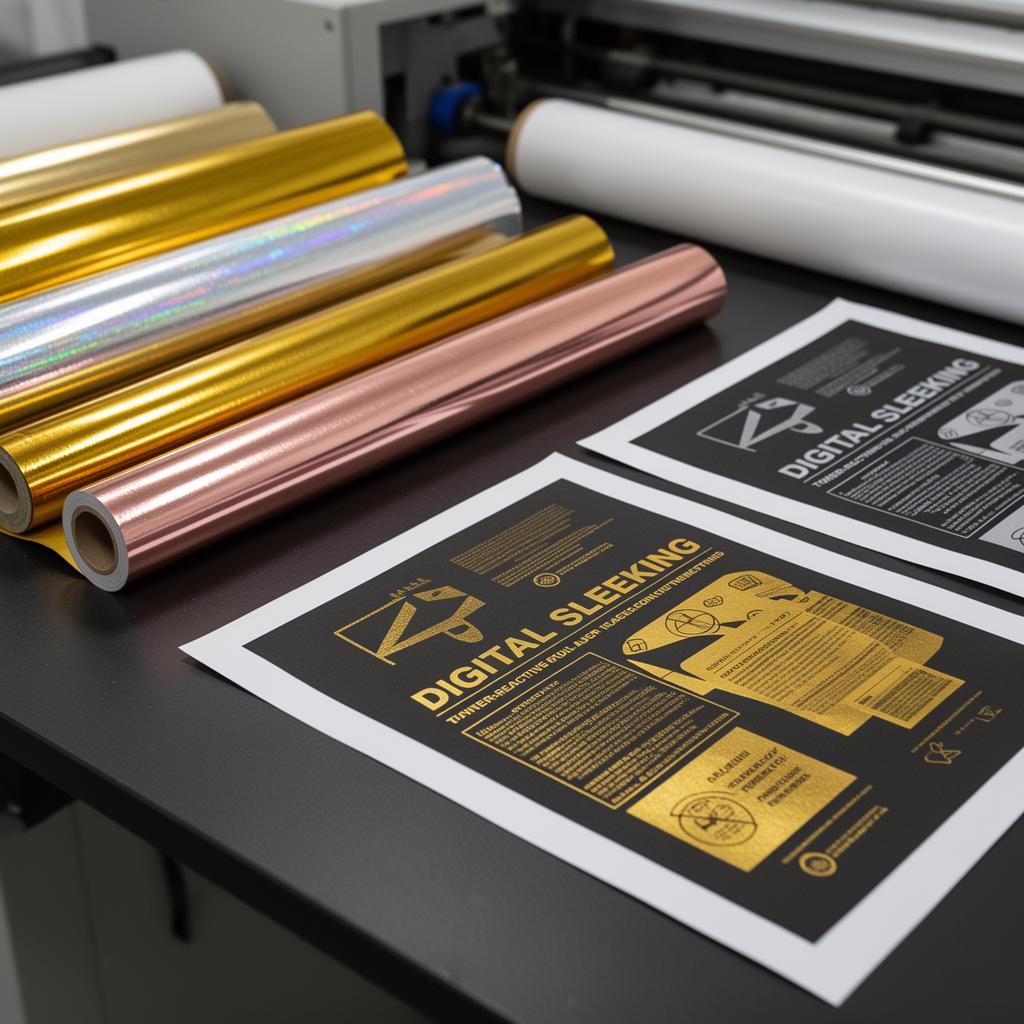
Toner reactive foil — also called toner foil, laser foil or digital sleeking foil — is a metallised transfer film that bonds only to laser-printed black toner. Supplied as continuous rolls for inline digital sleeking lines and as pre-cut A4 / A3 toner sheets for foiling for designers, wedding stationers and small print shops. This guide covers both formats: 16 stock colours, printer & sleeker compatibility, press settings, MOQ from 1 pack.
Reviewed by Gavin Gao, Technical Director
What is toner reactive foil — and what are toner sheets for foiling?
Toner reactive foil is a metallised transfer film whose heat-activated adhesive bonds only to dry electrophotographic (laser) toner. Run a black-toner laser print and the toner becomes the only place the foil can stick — every non-toner area releases cleanly back to the PET carrier. The result is digital, on-demand metallic decoration with zero die, zero plate, zero make-ready and full variable-data freedom.
Toner sheets for foiling are the same material supplied as pre-cut A4 (210 × 297 mm) or A3 (297 × 420 mm) sheets instead of rolls. They are designed for desktop laminator workflows used by designers, wedding stationers, photographers and small print shops. Format aside, the two are functionally identical.
Browse our matching Digital Toner Foil product page, read the sister Digital Foil Printing pillar guide, or compare against hot foil stamping and cold foil when you need analogue tooling.
How toner-reactive foiling works — 5-step process
Print with laser toner
Print the artwork on a standard mono or colour laser printer / copier. The black toner is the only ink that matters — it becomes the adhesive map.
Stack the foil
Place the toner reactive foil sheet shiny-side down over the print, so the foil's adhesive layer touches the toner image directly.
Run through the nip
Pass the sandwich through a heated nip at 110–125 °C, slow speed — pouch laminator, dedicated digital sleeker, or inline foiling module.
Cool, then peel
Let the stack cool to room temperature (10–20 seconds). Peel the PET carrier off in a single smooth motion — foil stays only on the toner image.
Inspect & finish
Inspect for pinhole misses (typically caused by under-cured toner). Optional second pass adds a clear overlay foil for extra gloss protection.
Toner reactive foil — formats compared
Same material, three formats. Pick by your equipment and run volume.
| Format | Typical User | MOQ | Best Equipment |
|---|---|---|---|
| A4 toner sheets (210 × 297) | Designers, wedding stationers, photographers, hobbyists | 1 pack of 10 sheets | Pouch laminator (Minc, Foilcraft, GBC HeatSeal) |
| A3 toner sheets (297 × 420) | Small print shops, wedding-suite producers | 1 pack of 10 sheets | A3 pouch laminator, GMP Sleek 12 |
| Rolls 320 / 330 mm | Mid-volume sleeking shops, digital embellishment lines | 1 roll (~38 m²) | Vivid Matrix MX-370, Foiltech FT-330 |
| Rolls 640 mm × 120 / 300 / 600 m | Inline B2 digital embellishment, MGI / Scodix backups | 1 roll (~77–385 m²) | Vivid Matrix MX-530, GMP Sleek 540 |
| Custom width 200–1,300 mm | OEM sleeking-line integrators | 500 m² | Konica AccurioShine 3600, custom OEM |
Toner reactive foil — technical specifications
| Parameter | Standard Grade | Premium Grade | Holographic / Brushed |
|---|---|---|---|
| PET carrier thickness | 12 µm | 16 µm | 16–19 µm |
| Aluminium layer | ~40 nm | ~50 nm | ~50 nm (embossed) |
| Activation temperature | 110–120 °C | 115–125 °C | 115–125 °C |
| Nip speed (laminator) | 0.3–0.5 m/min | 0.3–0.5 m/min | 0.3–0.4 m/min |
| Stock colours | 12 metallics + 4 specials | 12 metallics + 4 specials | 8 patterns / colours |
| Compatible printers | All mono + colour laser | All mono + colour laser | All mono + colour laser |
| Storage | 18–25 °C / 45–60% RH | 18–25 °C / 45–60% RH | 18–25 °C / 45–60% RH |
| Sealed shelf life | 18 months | 18 months | 18 months |
| MOQ — sheet format | 1 pack of 10 | 1 pack of 10 | 1 pack of 10 |
| MOQ — roll format | 1 roll (stock) | 1 roll (stock) | 1 roll (stock) |
Where toner-reactive foil and toner sheets for foiling are used
Save-the-dates, invitations, place cards, menus and thank-you cards — gold and rose-gold A4 toner sheets dominate boutique wedding work for 50–500-piece runs.
Variable-data foiled names on luxury cosmetics outers, fragrance gift boxes and limited-edition product launches — every unit unique without die changes.
Foil-decorated covers and slipcases on short-run photo books — rose-gold and copper outperform polished gold for skin-tone-compatible designs.
Foiled logos and edge accents on business cards, brochures and folders — print shops run on Vivid Matrix MX-370 / MX-530 in 24-hour turnaround.
Christmas, birthday and holiday card lines — holographic and brushed toner foil add craft-shelf appeal at unit costs that compete with offset metallic inks.
Limited-edition novels, art books and zine covers — A3 toner sheets with clear-overlay foil deliver gloss protection on every unit.
Technical Specifications FAQ
Q01What is toner-reactive foil?+
Toner-reactive foil — also called toner foil, laser foil, toner-activated foil or digital sleeking foil — is a metallised transfer film engineered to bond only to dry electrophotographic (laser) toner. When passed through a heated nip together with a black-toner laser print, the foil's heat-activated adhesive softens and bonds to the toner image (which acts as the glue). On every non-toner area, the foil releases cleanly back onto its PET carrier. The result is a metallic foil layer that perfectly matches the printed artwork — no die, no plate, no make-ready, 100% variable data ready.
Q02What are toner sheets for foiling — and how are they different from rolls?+
Toner sheets for foiling are the same toner-reactive foil construction supplied as pre-cut A4 (210 × 297 mm) or A3 (297 × 420 mm) sheets instead of rolls. They are designed for designers, wedding stationers, photographers and small print shops who run the foiling step through a desktop laminator or a small-format sleeking unit (e.g. Foilcraft, Deco Foil, Minc, GBC HeatSeal). Functionally identical to the roll version — the only difference is format, MOQ (sold by the 10-sheet pack instead of 77 m² roll) and lead time.
Q03How does toner-reactive foil actually work?+
Three layers, three temperatures: (1) Laser print the artwork using a standard mono or colour laser printer / copier — the black toner is the only ink that matters. (2) Stack the toner-reactive foil shiny-side down on the print. (3) Pass the sandwich through a heated nip at 110–125 °C (laminator, sleeking unit or inline digital sleeking module). Heat softens the foil's adhesive only where it touches plastic toner; on bare paper it does not bond. Peel cold and the foil stays only on the toner image. The same physics work on every laser print engine — HP, Canon, Xerox, Konica Minolta, Ricoh, OKI.
Q04Toner-reactive foil vs hot stamping foil vs cold foil — which to use?+
Toner-reactive foil = digital, zero tooling, perfect for short runs (1–5,000), variable data and personalisation; needs a laser print as 'glue', limited to A3 / SRA3 max sheet size on most sleeking units. Hot stamping foil = uses a heated metal die, best for runs >5,000 and embossed effects, but needs tooling for every artwork change. Cold foil = inline on offset/flexo presses, best for runs >50,000 with full-coverage metallics. For a one-off wedding suite of 200 invitations toner-reactive foil wins on every metric; for a 100,000-run perfume carton cold foil printing is the right tool.
Q05What printers and sleeking machines are compatible?+
Any laser printer / copier that fuses dry toner: HP LaserJet (mono + Color), Canon imageRunner / i-SENSYS, Xerox Versant / PrimeLink / VersaLink, Konica Minolta bizhub C-series and AccurioPress, Ricoh Pro C-series, OKI Pro1040 / Pro8432WT, Kyocera ECOSYS. The foiling pass runs through any of: pouch laminator (set to 110–125 °C, slowest speed), dedicated digital sleeker (Vivid Matrix MX-370 / MX-530, Foiltech, GMP Sleek, Kompac), inline digital-foil module on a Scodix / MGI JetVarnish / Konica AccurioShine. Inkjet prints do NOT work — they have no toner for the foil to bond to.
Q06What colours and finishes are available?+
Stock colours (both rolls and sheets): bright gold, rose-gold, silver, copper, champagne, gun-metal, red, blue, green, purple, black, white, holographic rainbow, holographic silver, brushed gold, brushed silver. Pearl / pastel and clear-overlay (used to add gloss over toner without changing colour) also stocked. Custom Pantone matching is available with 500 m² MOQ on rolls only — sheet format only ships in stock colours. All variants are compatible with mono and colour laser toner; coloured toner underneath shifts the perceived foil shade slightly, which designers sometimes use deliberately.
Q07What MOQ, sheet sizes and roll widths are available?+
Toner sheets for foiling: sold in 10-sheet retail packs (A4 or A3) for designers and 100-sheet trade packs for print shops — ship in 5–7 days from Shanghai, single pack MOQ. Roll format for inline sleeking lines: 1 roll MOQ on stock colours (320 mm, 330 mm, 640 mm widths × 120 m, 300 m or 600 m length). Custom widths from 200 mm to 1,300 mm with 500 m² MOQ. Free A4 swatch packs of all 16 stock colours ship within 5 business days.
Q08Are there storage and shelf-life requirements?+
Yes — toner-reactive foil is moisture- and temperature-sensitive. Store sealed in the original packaging at 18–25 °C and 45–60% RH, away from direct sunlight. Sealed shelf life is 18 months from production. Once a pack is opened, re-seal in a zip bag with the silica desiccant and use within 6 months. Foil exposed to >30 °C or >70% RH for extended periods can self-activate (foil sticks back to carrier), so air-conditioned storage matters for buyers in tropical and Gulf markets.
Free toner foil sample pack
Tell us your printer model and end-use — we'll ship an A4 swatch pack covering all 16 stock colours of toner reactive foil within 5 business days, free to qualified buyers.