
Technical Guide · 2026 Edition
Textile Finishing Foil — Heat Transfer Foil for Fabric, Garments & Footwear
Textile finishing foil — also called heat transfer foil, garment foil or fabric hot stamping foil — is a polyurethane-adhesive foil engineered to bond onto cotton, polyester, denim, leather and blends under a heat press. This guide covers the 6 textile foil families, fabric compatibility, press settings (140–160 °C, 10–15 s, hot peel), wash & rub fastness (AATCC 135, 25–40 cycles at 40 °C), and MOQ-from-1-roll sourcing for apparel, footwear, athleisure and accessories.
Reviewed by Gavin Gao, Technical Director
What is textile finishing foil?
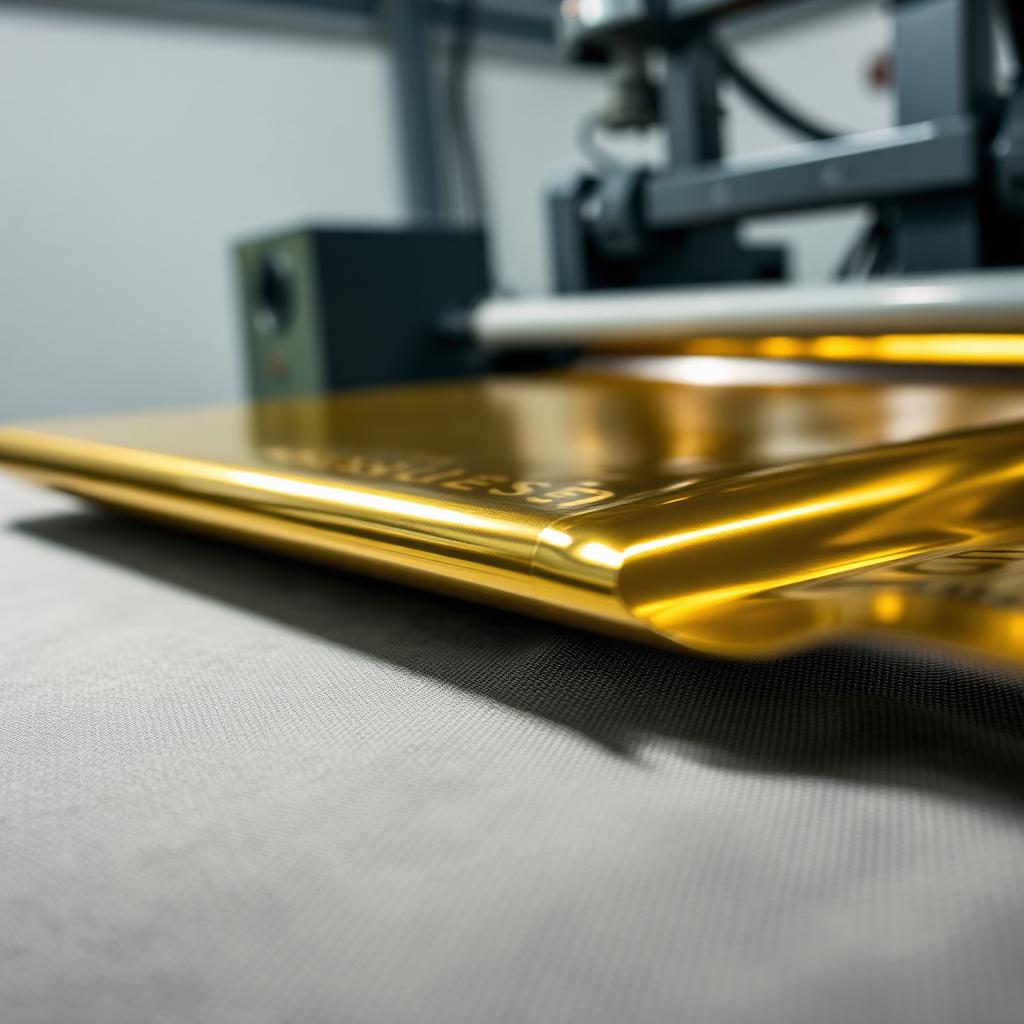
Textile finishing foil (also: heat transfer foil, garment foil, fabric hot stamping foil) is a hot stamping foil whose adhesive layer is reformulated from the stiff vinyl/acrylic system used on paper and board to a flexible polyurethane (PU) or co-polyamide (CoPA) hot-melt that penetrates fabric fibres and survives 40–60 °C wash cycles. Textile foil is engineered to stretch 15–30% without cracking, follow fabric movement, and pass AATCC 135 / ISO 6330 wash testing for 25–40 home laundry cycles. Used for logos, brand names, sports numbering, fashion graphics and trim on t-shirts, hoodies, athleisure, denim, footwear uppers and leather goods. Browse the matching Hot Stamping Foil range or compare against the rigid-substrate Hot Stamping pillar guide, holographic foil, pearlescent foil and matte foil families for paper and board.
How textile finishing foil is applied — 5-step heat-press sequence
Fabric prep & pre-press
Pre-press the garment area for 3–5 s at 130 °C to remove moisture and flatten fibres. Wet or fibre-raised fabric will cause uneven foil bond and silvering at the edges.
Adhesive layer application
For two-stage workflow: print or screen heat-transfer adhesive (HTA) into the artwork shape, or place a pre-cut PU adhesive film. Cure / tack at 130 °C × 5 s. Direct-stamp foil grades skip this step.
Foil lay-down
Lay the textile foil colour-side-up over the adhesive area. Use a Teflon or silicone cover sheet to protect the foil release layer and prevent scorching.
Heat-press cycle
Press at 140–160 °C, 3–4 bar pressure, 10–15 s dwell (two-stage) or 150–165 °C × 12–18 s (direct-stamp). Temperature and dwell tuned per fabric — synthetics run cooler, cotton runs hotter.
Hot peel & cure
PEEL HOT immediately while the foil is still warm — cooling before peel will tear the colour layer. Post-cure at room temperature for 24 h before first wash to allow full PU adhesive crosslinking.
Fabric compatibility — press settings by substrate
Always run a 3-sample wash test (AATCC 135, 40 °C, 25 cycles) before bulk production — fabric finish chemistry varies between mills.
| Fabric | Press Temp. | Dwell | Peel | Wash Cycles (40 °C) |
|---|---|---|---|---|
| 100% Cotton jersey | 155–165 °C | 12–15 s | Hot | 30–40 |
| 100% Polyester jersey / athletic | 140–150 °C | 10–12 s | Hot | 25–35 |
| Cotton/Poly 50/50, 65/35 | 150–160 °C | 12–14 s | Hot | 30–40 |
| Denim (cotton, raw / washed) | 160–170 °C | 15–18 s | Hot | 30–40 |
| Nylon / Lycra ≤ 8% | 140–150 °C | 10–12 s | Hot | 25–30 |
| PU & split leather, faux leather | 130–140 °C | 8–10 s | Hot | 20–25 (gentle) |
| Brushed fleece (smooth side) | 150–160 °C | 12–15 s | Hot | 20–25 |
| DWR / waterproof technical | Not recommended (request fluorine-resistant grade) | — | — | — |
6 textile foil families — pick by brand brief
| Family | Optical Effect | Best Fabric | Typical End-Use |
|---|---|---|---|
| Metallic Gold / Silver | Mirror metallic 85–95 GU | All | Fashion logos, sports numbering, luxury denim |
| Holographic | Rainbow / pillar / dot-matrix | Cotton, poly, blends | Streetwear, youth fashion, festival apparel |
| Pearlescent | Soft pearl 35–55 GU, two-tone | Cotton, poly | Premium bridal, women's apparel, kidswear |
| Matte (Gold / Silver / Black) | Low-gloss 5–15 GU | Premium knits, athleisure | Luxury logos, understated branding |
| Pigment colour (RGB-W-K) | Opaque solid colour | All | Full-colour brand graphics, large logos |
| Reflective | High-reflectivity silver / colour | Poly, blends, workwear | Safety vests, workwear, night-visibility activewear |
Textile finishing foil — technical specifications
| Parameter | Standard Apparel | Premium Fashion | Industrial Laundry |
|---|---|---|---|
| PET carrier thickness | 12 µm | 16 µm | 19 µm |
| Adhesive chemistry | Co-polyamide (CoPA) | Polyurethane (PU) | Reinforced PU + crosslinker |
| Aluminium layer | ~30 nm | ~50 nm (metallic) / ~30 nm (pearl) | ~50 nm |
| Press temp. | 140–155 °C | 145–160 °C | 150–165 °C |
| Dwell (heat press) | 10–12 s | 12–15 s | 15–18 s |
| Wash cycles AATCC 135 / 40 °C | 25–30 | 30–40 | 50+ |
| Industrial laundry (60–90 °C) | Not rated | 5–10 cycles | 30–50 cycles |
| Martindale dry rub | ≥ 150 | ≥ 200 | ≥ 300 |
| Stretch (no crack) | 15% | 20–25% | 25–30% |
| Service temp. | -20 to +60 °C | -30 to +70 °C | -30 to +80 °C |
| Roll width | 320 / 640 mm | 200–1,040 mm | 320–1,040 mm |
| MOQ | 1 roll | 1 roll (stock) / 1,000 m² (custom) | 1,000 m² |
| Lead time | 5–7 days | 5–7 days (stock) / 20–28 days (custom) | 25–35 days |
Where textile finishing foil is used
Metallic gold, holographic and matte black on t-shirts, hoodies, denim jackets and caps — the dominant decoration for premium streetwear logos and limited drops.
Metallic and reflective foil on team kits, sports numbering, athletic jerseys and yoga / running apparel — durable through 25–40 sports-cycle washes.
Metallic gold, silver and holographic accents on sneaker uppers, swoosh logos, heel tabs and tongue patches — applied with rotary or shoe-last heat presses.
Matte gold and matte silver on premium denim back-pocket logos, leather handbags, wallets and small leather goods — luxury luggage and accessories standard.
Reflective silver and reflective colour foil on safety vests, hi-vis jackets, hospitality uniforms and industrial workwear — qualified for industrial laundry cycles.
Pearl white, pink pearl and pigment-colour foil on bridal wear, christening gowns, kidswear graphics and decorative cushions / table linen.
Technical Specifications FAQ
Q01What is textile finishing foil?+
Textile finishing foil — also called heat transfer foil, garment foil or fabric hot stamping foil — is a polyester-carrier foil engineered to bond onto woven and knit fabrics (cotton, polyester, blends, leather, denim) under a flat or rotary heat press. Construction is a tuned 5-layer stack (PET 12–19 µm + release wax + colour/metallic coat + ~30–50 nm aluminium + textile-specific hot-melt polyurethane adhesive) where the adhesive system is reformulated for fibre penetration and 40–60 °C wash cycles rather than rigid paper/board substrates. Typical decoration is logos, brand names, sports numbering, fashion graphics and trim accents on t-shirts, hoodies, athleisure, denim jackets, footwear uppers and leather goods.
Q02Textile finishing foil vs paper / carton hot stamping foil — what's different?+
Three engineering differences. (1) Adhesive — textile foil uses a polyurethane (PU) or co-polyamide (CoPA) hot-melt that softens at 130–160 °C and penetrates fabric fibres; paper foil uses a stiffer vinyl/acrylic adhesive that bonds to coated surfaces at 95–135 °C. (2) Flexibility — textile foil is engineered to stretch 15–30% without cracking so the decoration follows fabric movement; paper foil is rigid and would crack on flex. (3) Wash & rub fastness — textile foil is qualified to AATCC 135 / ISO 6330 wash testing (typically 25–40 home washes at 40 °C) and Martindale rub testing; paper foil has no such qualification. Always order foil sold as 'textile' or 'heat transfer' grade — paper hot stamping foil will delaminate on the first wash.
Q03Which textile fabrics work with heat transfer foil?+
Best on smooth woven and tightly-knit fabrics: 100% cotton (jersey, twill, denim), polyester (jersey, micro-fibre, athletic mesh), cotton/poly blends (50/50, 65/35), nylon, lycra/spandex blends ≤ 8%, brushed fleece (smooth side), PU and split leather, faux leather, and microsuede. Difficult or not recommended: heavy pile fleece, terry towelling, deep-rib knits, water-repellent or DWR-coated technical fabrics (the coating blocks adhesion), 100% silk, and fabrics with high silicone softener finish. For waterproof technical garments, ask for a fluorine-resistant textile foil grade — standard PU adhesive will not bond to a DWR-finished surface.
Q04What press settings produce a clean, wash-fast foil transfer on fabric?+
Two-stage process. STAGE 1 — Print or apply a heat-transfer adhesive (HTA) layer first using a digital foil printer, a screen-printed HTA, or a pre-cut adhesive film, then cure / tack at 130 °C × 5 s. STAGE 2 — Lay the foil colour-side-up over the adhesive and press at 140–160 °C, 3–4 bar pressure, 10–15 s dwell, then PEEL HOT immediately. Cooling before peel will tear the foil layer. For direct-stamp textile foil (no pre-adhesive) on smooth synthetics, single-stage press at 150–165 °C × 12–18 s, hot peel. Always run a 3-sample wash test (AATCC 135, 40 °C, 25 cycles) before bulk production — fabric finish chemistry varies between mills.
Q05What wash and rub fastness should I expect from textile finishing foil?+
Production-grade textile foil with the correct PU adhesive system delivers: 25–40 home wash cycles at 40 °C (AATCC 135 / ISO 6330) without significant cracking, lifting or colour loss; ≥ 200 dry-rub and ≥ 100 wet-rub Martindale cycles without measurable abrasion; resistance to mild detergent and household bleach at consumer concentrations; -20 to +60 °C service temperature. Industrial laundry (60–90 °C, alkaline detergent, mechanical agitation) reduces these numbers significantly — for workwear, hospitality and hotel-linen applications request an industrial-laundry-grade foil with reinforced PU adhesive (qualified to 50+ industrial wash cycles).
Q06Which foil families are available for textile decoration?+
Six families ship as textile-grade variants. (1) Metallic gold and silver — the highest-volume textile foil, used on fashion logos, sports numbering and luxury denim. (2) Holographic — rainbow, pillar-of-light and dot-matrix patterns for streetwear and youth fashion. (3) Pearlescent — pearl white, champagne, pink pearl for premium bridal and women's apparel. (4) Matte — matte gold, matt silver and matte black for premium understated branding on athleisure and luxury knits. (5) Pigment colours — opaque red, blue, green, black, white for full-colour brand graphics. (6) Reflective — high-reflectivity foil for safety vests, workwear and night-visibility activewear. All six families share the same PU/CoPA textile adhesive platform.
Q07What is the MOQ and lead time for textile finishing foil?+
Stock textile foil (gold, silver, holographic rainbow, pearl white, matte black, reflective silver in 320/640 mm widths × 120/300 m): 1 roll MOQ, ships in 5–7 days FOB Shanghai. Stock colour pigment textile foil: 1 roll MOQ on red, royal blue, white and black; 1,000 m² MOQ on custom Pantone-matched textile colour, 20–28 days lead time. Custom-logo holographic textile foil: 3,000 m² MOQ, 35–45 days including embossing-master tooling. Free A4 swatch pack of all six textile foil families plus a 4-cycle wash-test sample shipped within 5 business days to qualified buyers.
Q08Can textile finishing foil replace screen printing or DTF for garment decoration?+
It complements rather than replaces. Foil is the best choice for: metallic / mirror / holographic / pearl effects (which screen and DTF cannot match), logos and brand marks under 100 cm² where a premium luxe finish matters, sports numbering with metallic shine, fashion-grade accents on denim and leather, and trim decoration on footwear and accessories. Screen printing remains better for full-coverage process colour graphics over large areas at high volume. DTF (direct-to-film) remains better for full-colour photo-realistic graphics. The typical premium garment combines DTF or screen-printed colour graphics + a foil-stamped metallic logo or accent — this is the standard luxury streetwear and athleisure decoration stack in 2026.
Free textile foil swatch + wash-test pack
Tell us your fabric and end-use — we'll ship an A4 swatch of all 6 textile foil families plus a 4-cycle AATCC 135 wash-test sample within 5 business days, free to qualified apparel, footwear and accessory buyers.