
Technical Guide · 2026 Edition
Scratch-Off Foil for Hot Stamping — Opacity Grades, Press Settings & Sourcing
Scratch-off foil is an opaque hot stamping foil that hides PINs, promo codes and prize fields until a coin removes it. This guide covers opacity compliance levels, press windows for paperboard and PVC cards, release-consistency QC, security upgrades and MOQ-from-1-roll sourcing.
Reviewed by Gavin Gao, Technical Director
60-Second Answer
Scratch-off foil for hot stamping is an opaque foil stamped over confidential print — a PIN, promo code or prize field — at 100–140 °C with 0.3–0.8 s dwell. The panel hides the data at ≥ 95% opacity (≥ 99% for prepaid and gaming) and releases cleanly when scratched with a coin. It replaces screen-printed latex with no drying oven and no ink waste. See the Scratch-Off Foil product page for live specifications.
Key Engineering Takeaways
- 01
Scratch-off foil is a hot-stamped opaque panel that replaces screen-printed latex — no drying oven, no ink kitchen, instant job changeover.
- 02
Opacity is the compliance metric: ≥ 95% for promotional codes, ≥ 99% plus IR-blocking tint for prepaid airtime, gift cards and gaming.
- 03
Press window is 100–140 °C, 0.3–0.8 s dwell, 2–5 bar — run 10–15 °C cooler on PVC/PET cards than on paperboard.
- 04
Release consistency comes from the wax coat weight; require a batch coin-abrasion QC report and ΔE ≤ 2.0 colour drift for reprint matching.
- 05
Security upgrades: holographic panel, tamper-evident VOID release, UV taggant under the panel, registered hologram registration ±0.15 mm.
- 06
MOQ from 1 roll for stock silver/gold, 500 m² for holographic and VOID grades; 5–14 day lead time from Shanghai.
What is scratch-off foil for hot stamping?
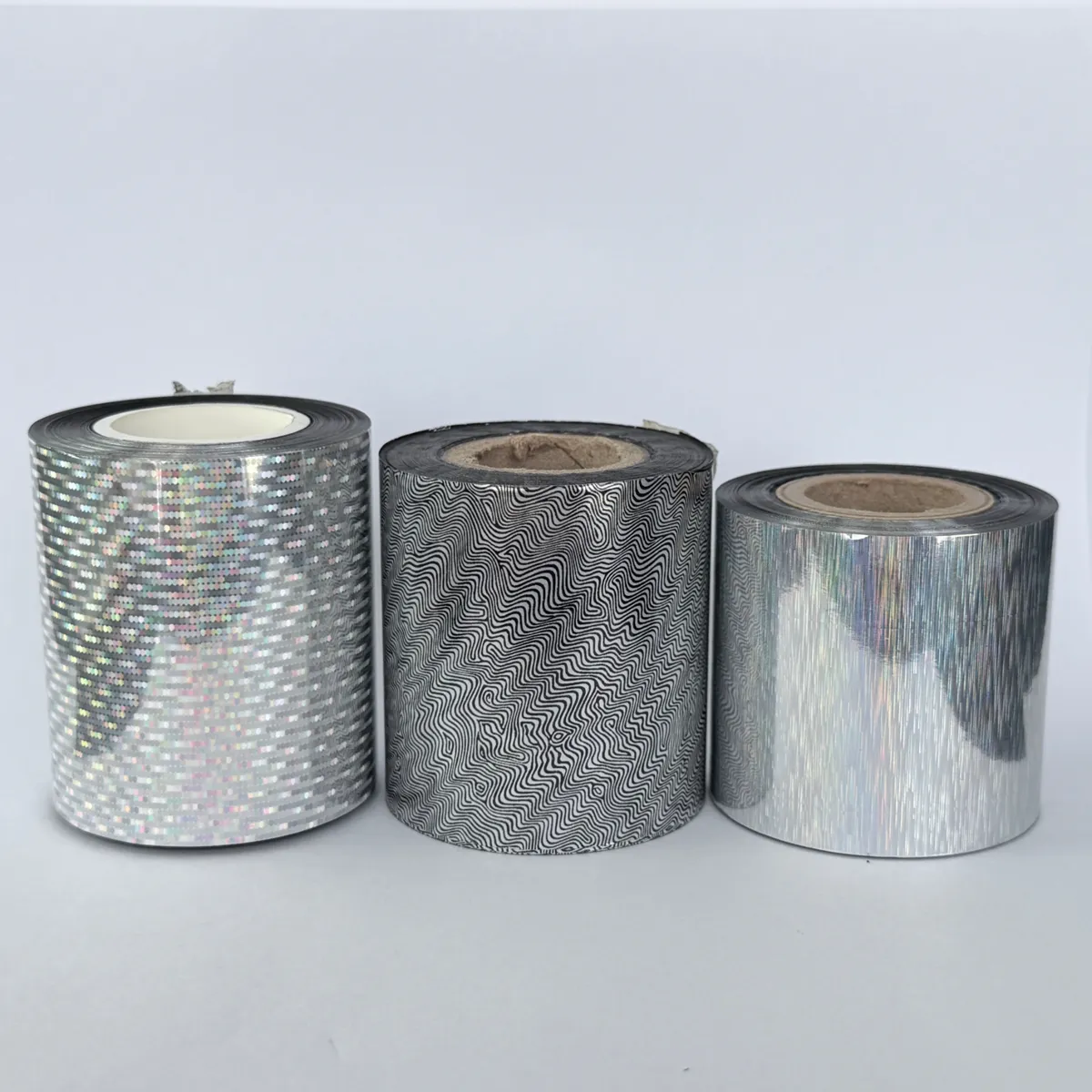
Scratch-off foil is a multi-layer transfer foil — PET carrier, release wax, opaque pigment/metallised layer and a heat-activated adhesive — engineered so the transferred panel bonds firmly enough to survive shipping and retail handling, yet abrades away under a coin. Because it applies on a standard hot stamping press, card and ticket producers can add scratch panels inline with their existing foiling and embossing work instead of outsourcing a screen-print pass. For the underlying foil construction see What is Hot Stamping Foil; for covert and overt anti-counterfeit layering see security foil. A full commercial walkthrough is available in our article Scratch-Off Foil for Hot Stamping: A Complete Buyer's Guide.
How a scratch-off panel is produced — 5-step sequence
Variable data printing
The PIN, code or prize field is printed by inkjet, laser or thermal transfer onto the ticket, label or card, then allowed to fully set before foiling.
Optional primer / barrier coat
On absorbent stocks a thin barrier coat prevents the code ink from migrating into the panel and stops solvent attack from tampering attempts.
Hot stamping the panel
A flat magnesium or brass die transfers the opaque foil at 100–140 °C, 0.3–0.8 s dwell and 2–5 bar, running 3,000–6,000 impressions/hour.
Opacity & release QC
Panels are checked under 1,000 lux transmitted light for readability, then coin-abraded on a standardised cycle to log removal force and edge cleanliness.
Overprint or laminate (optional)
A scratch-resistant varnish can be applied around — never over — the panel, plus tamper-evident VOID or UV taggant layers for high-value products.
Scratch-off foil grades — pick by end-use
All grades available in silver, gold and custom tints. Panel widths slit from 20 mm to 1,600 mm.
| Grade | Opacity | Key Feature | Best For |
|---|---|---|---|
| Standard Silver / Gold | ≥ 95% | Clean coin release, stock item | Promotional scratch cards, coupons, loyalty tickets |
| Security High-Opacity | ≥ 99% | IR / backlight blocking tint | Prepaid airtime, gift cards, gaming, lottery |
| Holographic Scratch-Off | ≥ 97% | Overt rainbow anti-counterfeit panel | Brand-protection promos, high-value prize tickets |
| Tamper-Evident VOID | ≥ 99% | Permanent VOID mark if lifted or solvent-attacked | Regulated gaming, banking PIN mailers |
| PVC / PET Card Grade | ≥ 97% | Low-temperature adhesive for plastic cards | Plastic gift cards, membership and SIM carriers |
Scratch-off foil — technical specifications
| Parameter | Standard Grade | Security Grade | Card Grade |
|---|---|---|---|
| PET carrier thickness | 12 µm | 16 µm | 16–19 µm |
| Opacity (transmitted light) | ≥ 95% | ≥ 99% + IR block | ≥ 97% |
| Stamping temperature | 110–140 °C | 110–140 °C | 100–125 °C |
| Dwell time | 0.3–0.8 s | 0.4–0.8 s | 0.3–0.6 s |
| Pressure | 2–5 bar | 3–5 bar | 2–4 bar |
| Press speed | up to 6,000 iph | up to 5,000 iph | up to 4,500 iph |
| Roll width | 20–1,300 mm | 20–1,600 mm | 20–1,300 mm |
| Roll length | 120 / 300 / 600 m | 120 / 300 m | 120 / 300 m |
| ΔE drift (roll-to-roll) | ≤ 2.5 | ≤ 2.0 | ≤ 2.0 |
| MOQ | 1 roll (stock) | 500 m² | 500 m² |
Where scratch-off foil is used
Prize fields on instant-win tickets — security grade with ≥ 99% opacity and IR blocking prevents pre-reading under backlight.
PIN concealment on paper and PVC cards; card grade runs 10–15 °C cooler to avoid substrate distortion.
Retail campaigns, on-pack promos and loyalty mailers — stock silver or gold from 1 roll with 5-day shipping.
Tamper-evident VOID grade leaves a permanent mark if the panel is lifted with tape or attacked with solvent.
Hidden seat upgrades, backstage codes and giveaway fields, stamped inline with existing foil branding.
Unique verification codes hidden under a holographic panel and paired with covert UV taggants for layered protection.
Technical Specifications FAQ
Q01What is scratch-off foil for hot stamping?+
Scratch-off foil is an opaque hot stamping foil engineered to be removed with a coin or fingernail after application. It is stamped over the confidential data — a PIN, promo code or prize field — at 100–140 °C, forming a fully opaque silver, gold or holographic panel that hides the print underneath but releases cleanly when abraded. Unlike screen-printed scratch-off latex it needs no drying oven, no ink kitchen and no separate curing pass; it runs on any existing hot stamping press.
Q02Scratch-off foil vs scratch-off latex ink — which should I use?+
Scratch-off foil wins on short and medium runs, on-demand personalisation and mixed substrates: zero ink waste, no drying line, instant job changeover, and a metallic or holographic look that latex cannot match. Screen-printed latex is cheaper per m² at very high volumes (millions of lottery tickets) but requires screen setup, solvent handling and drying capacity. Many card producers run both — foil for promotional and prepaid cards, latex for national lottery runs.
Q03What opacity is required to hide a printed PIN code?+
A compliant scratch-off panel must reach an optical density that makes the code unreadable under 1,000 lux transmitted light. Our standard grade reaches ≥ 95% opacity in a single stamped pass; the Security grade reaches ≥ 99% and adds a tint layer that also blocks IR/backlight reading — the standard demanded for prepaid airtime, gift-card and gaming applications. Always request an opacity test report with your sample order.
Q04What press settings does scratch-off foil need?+
Typical window: 100–140 °C die temperature, 0.3–0.8 s dwell, 2–5 bar pressure, running at 3,000–6,000 impressions/hour on a platen press. Use a flat magnesium or brass die with even make-ready — pressure variance is the number one cause of streaky panels. Run 10–15 °C lower on PVC and PET cards than on paperboard to avoid substrate distortion.
Q05Which substrates does it adhere to?+
Coated and uncoated paperboard, label paper, thermal ticket stock, PVC and PET cards, and pre-varnished surfaces when the varnish is stamp-receptive. For plastic cards specify the PVC-adhesive grade. Always pre-test over the exact overprint varnish or toner you use: a slip-additive varnish can under-anchor the panel, causing it to lift at the edges instead of scratching off cleanly.
Q06How is scratch release consistency controlled?+
Release is governed by the wax/release-layer coat weight, cured within a tight window so the panel neither flakes prematurely nor resists a coin. We test every batch with a standardised coin-abrasion cycle and log the removal force; batch-to-batch ΔE colour drift is held ≤ 2.0 so reprints match the original run. Ask for the batch QC sheet — a supplier who cannot produce one is a sourcing risk.
Q07Can scratch-off panels carry security features?+
Yes. Options include a holographic scratch-off layer (overt anti-counterfeit), tamper-evident VOID release that leaves a permanent mark if lifted with tape or solvent, UV-invisible taggants under the panel, and registered holographic patterns. Layer these with security foil for full brand protection on high-value prepaid and gaming products.
Q08What is the MOQ and lead time?+
Stock silver and gold scratch-off foil: 1 roll (~640 mm × 120 m), shipping in 5–7 days. Holographic and tamper-evident VOID grades: 500 m² MOQ, 10–14 days. Custom-width slitting from 20 mm to 1,600 mm is free on orders above 500 m². Free A4 sample cards with a live scratch test ship within 5 business days to qualified buyers.
Free scratch-off foil sample cards
Tell us your substrate, panel size and opacity requirement — we'll ship live scratch-test sample cards in silver, gold and holographic within 5 business days, free to qualified buyers.