
Process Guide · 2026 Edition
Hologram Hot Stamping — Patterns, Registration & Specs
How a holographic foil stamp is produced: stock patterns versus registered holograms, press settings that keep the rainbow bright, transfer foil for textiles, MOQ and lead times.
Reviewed by Gavin Gao, Technical Director
The Direct Answer
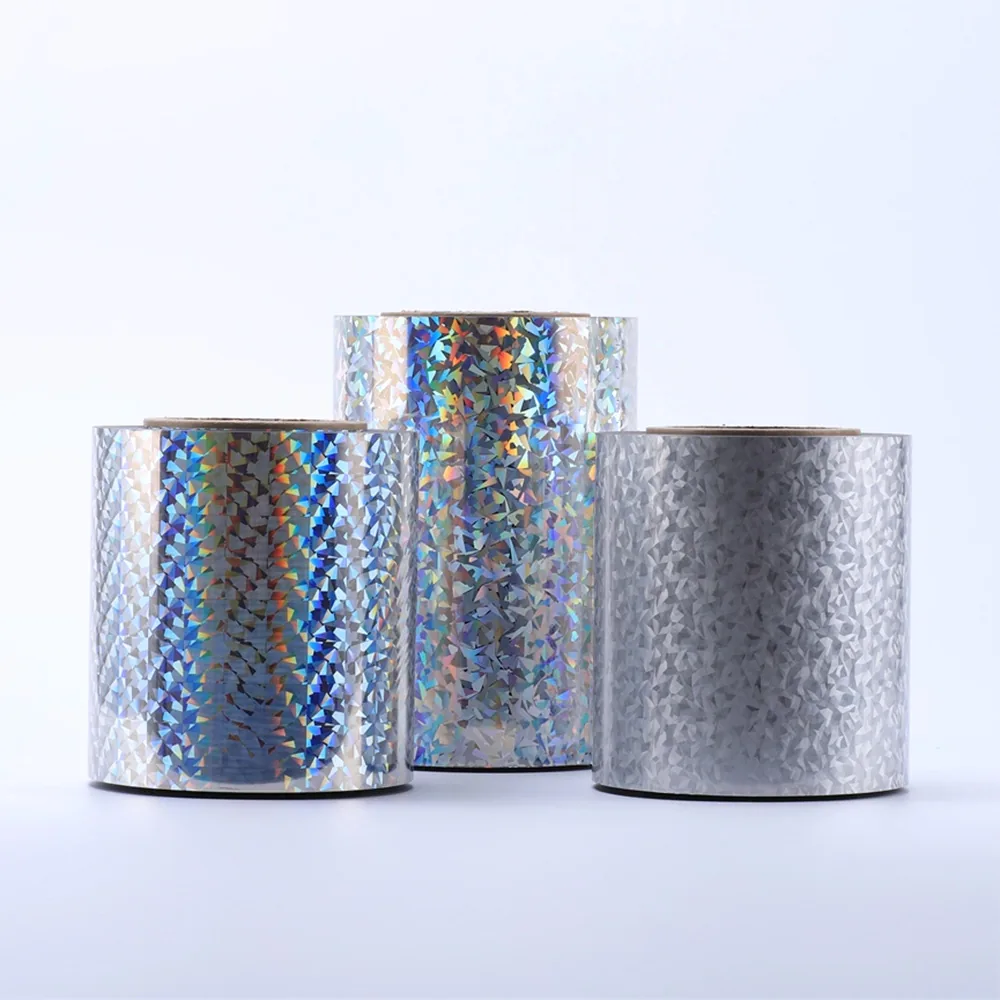
Hologram hot stamping transfers a foil carrying a nanoscale diffraction grating onto paper, board, film or textile with a heated die at 105–135 °C. Stock patterns — rainbow, fine pillar, dot-matrix, seamless star — are decorative and ship from one roll; registered holographic foil is aligned to the die within ±0.15 mm and works as a genuine anti-counterfeit feature. See the holographic rainbow foil product page.
Key Engineering Takeaways
- 01
Hot stamp hologram uses the same presses and settings as metallic foil — 105–135 °C, 0.3–0.8 s dwell; the rainbow is structural, not a pigment.
- 02
Generic patterns are decoration and ship from stock; registered holograms are security features and need an origination master.
- 03
Never exceed 140 °C: excess heat relaxes the diffraction grating and visibly dulls the effect.
- 04
Registered hologram stamping requires electronic foil registration to ±0.15 mm.
- 05
Holographic transfer foil (PU adhesive, 140–160 °C × 10–15 s) is the textile grade — paper-grade foil cracks on fabric.
- 06
Stock patterns from 1 roll in 5–7 days; registered holograms from 2,000 m² in 25–35 days.
Holographic foil stamp vs holographic foil stamping
A holographic foil stamp is the finished decoration; holographic foil stamping is the process that produces it. Both depend on three choices — pattern, registration, and substrate grade. The optical physics, pattern catalogue and shade options live in the holographic foil guide; covert and tamper-evident features are in security foil; the see-through variant is in transparent foil. For cool-toned mirror holograms see silver foil stamping, and for the press-side fundamentals see the hot stamping pillar guide.
Generic vs registered vs transfer grade
Same optical principle, three very different supply routes.
| Grade | Pattern | Registration | MOQ | Lead Time | Typical Use |
|---|---|---|---|---|---|
| Stock generic | Rainbow, pillar, dot-matrix, star | Not required | 1 roll | 5–7 days | Gift wrap, promo, packaging accents |
| Custom continuous | Brand pattern, repeating | Not required | 1,000 m² | 18–25 days | Own-look decoration at volume |
| Registered hologram | Discrete brand image | ±0.15 mm | 2,000 m² | 25–35 days | Anti-counterfeit labels & cartons |
| Holographic transfer foil | Rainbow, pillar | Not required | 500 m² | 10–14 days | Apparel, bags, footwear |
Where hologram stamping is specified
Registered holograms with hidden micro-text and tamper-evident VOID release for pharma, spirits and spare parts.
Seamless star and rainbow patterns in wide 640–1,600 mm rolls.
Fine pillar and dot-matrix accents that catch movement on shelf.
Dot-matrix kinetic patterns, often combined with spot varnish.
Holographic transfer foil with PU adhesive, 25–40 wash cycles.
Registered holograms on narrow slit rolls for inline label presses.
Frequently asked questions
Q01What is hologram hot stamping?+
Hot stamp hologram (also written holographic foil stamping) is the transfer of a holographic foil onto a substrate with a heated die. The foil carries a nanoscale diffraction grating embossed into the layer beneath the aluminium; when light hits the grating it is split into a moving spectrum, producing the rainbow shift. Press settings are the same as any metallic foil — 105–135 °C, 0.3–0.8 s dwell — because the effect is structural, not chemical.
Q02What is the difference between generic and registered hologram stamping?+
Generic (continuous) holographic foil carries a repeating pattern — rainbow, fine pillar, dot-matrix, seamless star — so the die can land anywhere on the web. Registered holographic foil carries a discrete, customer-specific hologram image that must be aligned to the die within about ±0.15 mm, which requires a press with an electronic foil-registration unit. Generic foil ships from stock; registered foil needs an origination master, 2,000 m² MOQ and 25–35 days. Security applications are covered in the security foil guide.
Q03Can a holographic foil stamp be used as an anti-counterfeit feature?+
A generic rainbow pattern is decoration, not security — anyone can buy the same roll. Real protection comes from a registered hologram made from your own origination master, optionally with hidden layers: micro-text, nano-text, dot-matrix kinetic movement, guilloche, CLR (covert laser readable) and tamper-evident VOID release. Those features cannot be reproduced by scanning or photocopying. We supply the origination and hold the master exclusively for the brand owner.
Q04Which hologram pattern should I choose?+
Rainbow is the general-purpose choice and the brightest under diffuse retail light. Fine pillar gives a tighter, more premium shimmer on small type. Dot-matrix produces kinetic movement as the pack tilts — the most eye-catching on shelf. Seamless star and geometric patterns suit gift wrap and children's products. Transparent holographic gives the diffraction effect without hiding the printed artwork underneath; see the transparent foil guide.
Q05What is holographic transfer foil?+
Holographic transfer foil is the heat-transfer grade used on textiles, leather and moulded plastics rather than paperboard. It uses a PU adhesive and a heat press at 140–160 °C for 10–15 s, and survives 25–40 wash cycles under AATCC 135. Apparel, bags, footwear and sports merchandise use this grade; the paper-grade foil will crack on fabric flex. Full detail in the textile finishing foil guide.
Q06What press settings does hologram stamping need?+
Coated board: 105–130 °C die temperature, 0.3–0.8 s dwell, medium pressure. Do not exceed 140 °C — excess heat can partially relax the embossed grating and visibly dull the rainbow, which is the most common cause of a 'flat' hologram stamp. Uncoated and kraft stocks need longer dwell rather than more heat. Registered foil additionally needs the press registration unit tuned to the repeat length of the hologram web.
Q07Can I combine hologram stamping with other decoration?+
Yes. Common combinations are hologram plus flat metallic in two passes, hologram over a cold-foil silver base for large coverage, and combination emboss-plus-hologram using a brass die for a raised, moving crest. Overprinting CMYK on top of a holographic base creates tinted holograms — gold, blue, pink — from a single silver-based roll.
Q08What is the MOQ and lead time for holographic foil?+
Stock generic patterns (rainbow, fine pillar, dot-matrix, seamless star): 1 roll, 5–7 days from Shanghai. Custom continuous patterns: 1,000 m², 18–25 days. Registered holograms with an origination master: 2,000 m², 25–35 days including artwork proofing. Custom widths 30–1,600 mm. Free swatch packs of the stock patterns are available to qualified buyers.
Spec your hologram in 24 hours
Send the pattern, roll width, substrate and whether you need registration — we reply with FOB pricing, origination cost where relevant, and lead time.